Happy Perfect Date to all who celebrate it!
 hometown 4.5.18+hometown-1.2.1
Blind/low vision #artist, #ecologist, and occasional #author. enby she/they. reformed physicist. defender of lost causes.
mostly #bugs
Jetzt in Deutschland!
header: a sleeping bee, curled up inside a yellow flower.
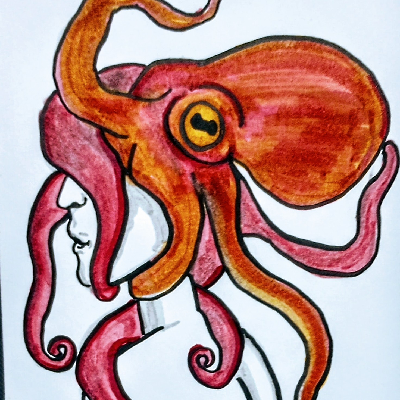
profile pic: drawing of a person with an octopus wrapped around their head, covering their eyes.
Happy Perfect Date to all who celebrate it!
Feeling nostalgic about the Megachile bee that absolutely decimated the hollyhocks growing in front of my house last summer.
Kind of chilly this morning and I found a wasp clinging to my watering can, so I transferred her to a flower in the sun so she could have a snack while she warmed up.
Today for #MarshMadness I have a large marsh grasshopper, Stethophyma grossum. Threatened in the UK by habitat loss and poor water quality, the large marsh grasshopper is being bred in captivity so it can be reintroduced as part of rewilding projects.
Today for #MarshMadness I have a water stick bug, Ranatra linearis, which is also called a water scorpion, or the Germans call it a Stabwanze. They breathe underwater through the siphon tail, waiting patiently to snatch up their prey.
Oh no, it's #GoblinWeek! To celebrate I like sharing some of the more goblin-y insects out there. Here are two paintings I did last year.
Junk bugs are the larvae of the pretty and delicate green lacewings (family Chrysopidae). They are known for collecting debris and the dead bodies of their victims on their backs.
The gum leaf skeletonizer (Uraba lugens) is the caterpillar of a small brown moth. As it grows and sheds old exoskeletons, it keeps the old head caps, wearing them like a silly hat.
Today for #MarshMadness I've painted a marsh springtail, Isotomurus palustris. Springtails are not insects but their own class of hexapods called Collembola. They are named for the tail-like appendage (furcula) which is held under tension beneath the abdomen. When released it snaps against the ground, propelling the springtail through the air.
Today, for this last day of #MarshMadness I've painted an American carrion beetle, Necrophila americana. These unfortunately named scavenger beetles are frequently found on dead animals and can be used in forensics.
Apparently, it can be confused for a cuckoo bumblebee, Bombus (Psithyrus) ashtoni, to which it bears little more than a passing resemblance - the difference, apparently, is that the bumblebee has a less hairy abdomen. Somewhat absurdly, the Wikipedia article asserts (without citation) that there is at least "one instance where N. americana was collected instead of P. ashtoni by mistake". I wish I had the paper where this mistake was made because I am certain it can serve as a warning that edibles and field research do not mix.
For #MarshMadness today I have a praying lacewing, Mantispa styriaca. The larvae of these guys demolish the eggs of fisher spiders then pupate inside their protective egg sacs, which the spiders continue to unwittingly carry around wherever they go. Adults use their mantid-like forelegs to snatch prey right out of the air.
Today for #MarshMadness I have a swamp metalmark, Calephelis muticum. These increasingly rare butterflies depend on swamp thistles as a host plant, and are thus threatened by invasive plant species as well as habitat loss and pollution.
Today for #MarshMadness I have Osmia bicolor, a mason bee known for building its nests inside the empty shells of snails. Each shell can hold 4-5 cells, one egg per cell, which is constructed from chewed up leaves and provisioned with balls of pollen mixed with nectar. The snail shells are then sealed up with sand and gravel, partially buried, and covered with twigs and grass for added protection.
I stumbled across a bee orgy today while walking my extraordinarily patient dog. Likely Colletes cunicularius, the spring mining bee. Males emerge shortly before the females, then hang around their nests to wait for them to emerge so they can be the first to mate. Often this results in little balls of horny bees. The female had quite enough of the harassment (and my nosiness) and ended up flying off shortly after this picture was taken, with one of the males still attached 😳
Every time I go for a walk with @j4yc33@infosec.exchange
There are at least two of these mason bees going into the hole. One of them brings mud in. The other takes it out and flies it over to the hole in the window, presumably for her own nest.
Work smarter, not harder?
For #MarshMadness and #WeevilWednesday I have a duckweed weevil, Tanysphyrus lemnae. The larvae mine through duckweed, leaving behind tiny characteristic holes in the floating leaves.
I now have a webpage to show the world how much I love #BeeButts!
Me: *goes outside to photograph bees*
The sun that woke me up at 5 in the morning for no goddamn reason: *disappears*
I've been roasting under the sun all day trying to snap one of the bees that's making a nest in this hole in my window... This is the best I've gotten so far.
#bee #beeButts #insect #pollinators
This #AprilFools day, you might be forgiven for getting tricked by this flower, especially if you're a horny male digger wasp of the species Argogorytes mystaceus. The fly orchid, Ophrys insectifera, has evolved to mimic female wasps, if not necessarily in appearance then in scent, using pheromones to draw in males and covering them in pollen when they attempt to mate with the flowers.
Today's #InsectArt comes courtesy of my 11 year old... They found a cool bug at the park and drew it so I could try to identify it. Best I can offer is some sort of beetle grub... Focus on the raster bristles next time, kid.
A person claims to be psychic and attempts to prove it by predicting the outcomes of a near infinite number of coin tosses. Predictably (ha!), they are wrong about 50% of the time. Sometimes they get some pretty good streaks where they guess the outcome correctly several flips in a row, but it is balanced out by equally bad streaks where they guess incorrectly several times in a row.
Is the person lying the whole time, or are they only lying/hallucinating the times they are wrong?
This post is about AI.
Happy #MothersDay! Here are some mamas of the invertebrate world.
Some masonry work going on in my house.
Learning that bees in Germany also observe "Sonntag ist Ruhetag" but I was at least able to catch this tiny friend. Lasioglossum of some sort?
#bee #bees #pollinators
Apropos of nothing, today I'm sharing an old watercolor of a honey bee, Apis mellifera. The sex of honey bees (like most Hymenopterans) is determined by their number of chromosomes. Females are diploid, containing two sets of chromosomes, and develop from fertilized eggs. Males are haploid, with only one set, developing from unfertilized eggs.
All workers in a honey bee hive are female; the drone's only job is to go out and mate with a new queen, a task which is invariably fatal. When autumn rolls around, any remaining virgin drones are summarily kicked out of the hive, quickly dying from exposure to the elements. This prevents them from wasting valuable resources over the cold winter.
Thus, the honey bee rightfully declares: No Kings.
Eine Schnecke!
Happy #WorldAutismDay - enjoy a free book (or two) from a neurodiverse author! I write characters that are on the spectrum because I think representation is important.
In Wild Things, Oz is a pre-teen prone to long rambling monologues and sensory overload. They also happen to have bees living in their chest... After the death of their grandmother, Oz is forced to face the real world and find some friends to help save their cabin in the woods from destruction.
Wild Things is free to download from https://books2read.com/b/3y667v
Someone down the street from me has a glittery lawn? Like it's been covered in sparkly spray paint.
I can't believe I have to say this but lawns are already bad enough for the environment, please don't decorate them with microplastics.
Letting my #WritersBlock demons win today.
I'm working on putting up previous years' #Septembee watercolors on my website! My next step will be adding a little blurb about each bee like I do for my posts here.