John Altringham
Ecologist and conservation scientist (emeritus prof.) in despair over inaction on climate change and biodiversity crises. Mountain-lover. Artist. Live in northern England. Often in Scotland.
Most posts auto-delete after two months. All photos and other artwork mine. No AI.
A short walk around some of Ilkley Moor's Bronze Age carved stones and other monuments. Map, GPS track, description and photos.
Plus four extra photos: 12 Apostles Circle, Badger Stone, Pepperpot and Barmishaw Stone.
The geologist James Hutton was born in Edinburgh 300 years ago tomorrow. Two slices of Scottish geology I (an ecologist) have enjoyed studying. The Moine Thrust Mylonites at Faraid Head, Balnakeil Bay and lichens on a basalt dyke in Lewisian gneiss, Raasay.
My aim is to learn by working from blocks to finished multi-colour print. Reduction engraving will be faster and more efficient, since after printing a layer I do only a little new engraving on the same block for the next layer. But I can’t print that layer again, I’ve destroyed it. If I make 50 prints off a layer that’s all I will ever have. If I spoil some as I overprint later layers, I have even fewer. Get it right and I save time and expense.
Until Plan B emerges, here’s the Matterhorn. 2/2
#WorldCurlewDay, a day when the curlew stands for all species caught in the climate and biodiversity crisis. I will take a walk on the moor after lunch and be grateful for their presence.
Thursday 30 April, swifts over the house, the first in 2026 and a week earlier than usual.
Putting on a show in the garden today, two member of the lily family, snake's head fritillary and dog's tooth lily (also fawn/trout lily). Details in ALT text.
The second print of the day, a 15x5 cm lemonwood engraving of Liathach, Torridon, NW Scotland. Almost everything in view is 1,000 M year old Torridonian red sandstone, the deep beds tilting gently down to the left. From photos taken on a hot afternoon in May 2025, the deep north-facing corries just in shadow.
Warm light in a cold, winter sunset at Byland Abbey in N Yorkshire, England, January 2025. A year later, a wood engraving in progress, the first test print made this morning.
Byland Abbey is one of several mediaeval monastic ruins in the area built in beautiful local sandstone/limestone which changes with the light from austere grey to gold.
Just before I took the photos, this coal tit was working round the stonework of our dining room window, searching for tasty spiders and webs for nest-building.
Multi-colour prints Plan B: two blocks, background and master reduction block
Photo: prepared block before inking. Inked master block with plan drawn directly on the block, from a tracing of a scaled photo. NB drawing on block is reversed. Background block - only the boundaries between stone and sky/grass are drawn.
Next step - watercolour sketch to plan reduction engraving: pale sunlit stone to deep shadow.
Reminder - full plan as a single “Diary” page on my website https://www.johnaltringham.co.uk/
First test print of a 10x10cm wood engraving in progress - part of the ruined 12C monastery of Rievaulx, N. Yorkshire. There is still work to be done.
Many hours in I realised I had forgotten to reverse the drawing. The print is therefore the mirror image of reality. This is the first time I have made this mistake and hopefully the last. I can reverse a digital reproduction, but anyone who gets an original print will have to live with an alternative reality.
One more month and swifts will return
In the teeth of it all
Screaming
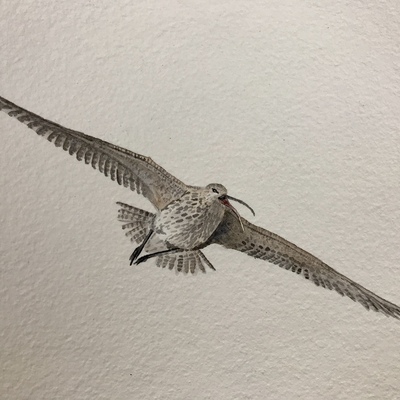
Howling wind and rain, the moor half-hidden in cloud. Sketching curlews throwing shapes.
Watercolour time. Balnakeil Bay and a fog-bound Cape Wrath. 22x7 cm, painted on the edge of an earlier disaster.
Time to try several layers of different colours in my wood engraving, by multi-block and reduction methods. First, familiarisation with colour inks using existing blocks and thinking through the challenge of accurate layer to layer registration on this small scale.
Multi-colour prints: a change of plan. I chose the block per layer method to avoid reduction engraving. I now think reduction suits this project better.
With one block per layer I make a complete set of blocks and can make as many prints as I want, again and again. However, that’s a lot of engraving, some of it repetitive. I learned early that lowering or ‘clearing’ any large areas of a block not to be printed is surprisingly time-consuming, for reasons I’ll explain in due course. 1/2
On this wet morning, listening to Lau...
https://www.youtube.com/watch?v=4wlRTM3y-qg