0xDE
I'm a computer scientist at the University of California, Irvine, interested in algorithms, data structures, discrete geometry, and graph theory.
The circle packing theorem (https://en.wikipedia.org/wiki/Circle_packing_theorem): every planar graph can be represented by the tangencies of a system of non-overlapping circles.
This theorem was proved by Koebe in 1936, and popularized in the 1980s by Fields medalist William Thurston as a discrete analogue to conformal mapping and uniformization. Its Wikipedia article was created by Oded Schramm in 2008, not long before his untimely mountaineering death. In his own research, Schramm found deep analogies between random walks on circle packings and Brownian motion. My interests in circle packing relate to its use in drawing graphs, constructing polyhedra for given graphs, modeling soap bubble foams, and finding planar separators. And others have found even more varied applications from the study of discrete symmetry groups of hyperbolic space to methods for visualizing the functional areas of the human brain, spread out into a flattened map.
Now a Good Article on Wikipedia.
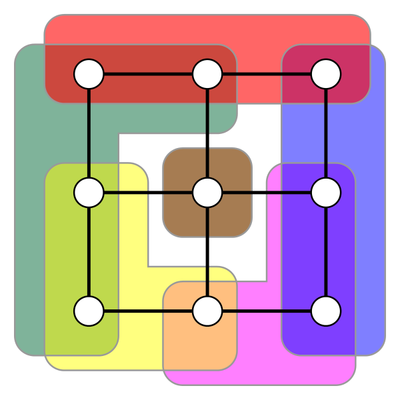
You might know that if you make a Sierpinski tetrahedron (by subdividing a regular tetrahedron into four smaller tetrahedra at its corners and a central regular octahedron, removing the octahedron, and recursing) and then stop after finitely many levels, you get a set of vertices that from certain directions projects onto a square grid. But did you know that listing the third (projected out) coordinate for these grid points gives them the structure of a Latin square? And that using a different Latin square than the 2x2 one as the basis for recursion can produce other fractal sets that have the same property of projecting to a square from certain directions? See section 4 of Hideki Tsuiki's "Imaginary Cubes — Objects with Three Square Projection Images", https://archive.bridgesmathart.org/2010/bridges2010-159.pdf
ICML'26 had two groups of reviewers, one for which LLM use was forbidden and another for which it was not. Reviewers could state their preference and only those who claimed to be ok with forbidding LLM use were assigned to that group. But then, ~500 of the reviewers in the LLM-forbidden group were caught using LLMs through hidden watermarks in the papers they reviewed. As a consequence, ~400 of those reviewers had their submissions desk-rejected (~500 rejections). https://blog.icml.cc/2026/03/18/on-violations-of-llm-review-policies/ via https://retractionwatch.com/2026/03/28/weekend-reads-illicit-ai-use-peer-reviews-commentary-talc-retracted-coauthorship-traded-commodity/
New arXiv preprint, "Sudoku Grids That Require Many Clues" (with Cindy Zhang, a UC Irvine undergraduate), https://arxiv.org/abs/2607.05728 and new blog post, "Packing Latin squares into sudoku puzzles", https://11011110.github.io/blog/2026/07/07/packing-latin-squares.html
The paper uses a counting argument to show that, when you generalize sudoku to larger squares, most of the puzzle needs to be covered by clues in order to make the solution unique, leaving only a smaller number of blank squares to puzzle out and making algorithmic time bounds for solving these puzzles faster. The blog post illustrates a construction that there wasn't room in the paper to explain in more detail, packing \(n^2\) Latin squares of size \(n\times n\) into a sudoku puzzle of size \(n^2\times n^2\).
Today's useless advice about making technical online content accessible, from my university's head bureaucrat for online content accessibility bureaucracy (but I repeat myself):
"I would recommend avoiding PDFs altogether. They are extremely difficult to make accessible. If PDF format is absolutely necessary, create a document in Microsoft Office and then save it as a PDF."
Meanwhile, TeX Live 2026 + ltx-talk has been working for me in making pdf-format slide decks that pass all Acrobat accessibility checks, and I have moved on from experiments in using it (https://11011110.github.io/blog/2026/03/01/making-accessible-latex.html) to using it in production for all my course lecture slides. There is no real alternative to some form of TeX for content involving mathematics. This works. And if you're already using LaTeX + beamer, it's not difficult.
The Brouwer fixed point theorem in action, as exhibited by Github labels: If you try to define a continuous function from text colors to contrasting background colors, there will be some text colors whose background is the same as the text rather than contrasting with it. Discontinuity is necessary to avoid this.
"Why some GitHub labels illegible", @MoritzFirsching@mathstodon.xyz, https://firsching.ch/github_labels, via @MoritzFirsching@mathstodon.xyz – see also https://en.wikipedia.org/wiki/Brouwer_fixed-point_theorem
This is from 2023 so I suspect the specific buggy behavior is long fixed but the phenomenon will recur for any attempt like this one to define a formula using only continuous building blocks.
A reduced planar body with area greater than \(\pi\Delta^2/4\), new preprint https://arxiv.org/abs/2606.28612 by Scott Duke Kominers
Here, "reduced" is a concept for two-dimensional convex bodies that is closely related to having constant width. The directional width is the distance between parallel support lines, constant width means that all directional widths are the same, thickness means the minimum directional width, and reduced means that any convex body that is a proper subset has smaller thickness. So bodies of constant width are reduced but not necessarily vice versa. For instance both Reuleaux triangles and equilateral triangles are reduced; the first has constant width, the second does not. A structure theorem described in the paper states that reduced bodies have parts of their boundary with constant width and parts that are flat.
Anyway, it had been conjectured that the formula in the title was the maximum area for a reduced body of thickness \(\Delta\), with bodies attaining that area including the circular disk and quarter-disk. As evidence for the conjecture, it is true both for shapes of constant width and for polygons. But the paper describes a shape resembling a sharper wedge of a disk than a quarter, with a rounded apex, that slightly betters this area.
Today I learned (through a newly-added Wikipedia article) that Uruguay has a museum devoted to #origami, claimed to be the only one in the Americas: https://en.wikipedia.org/wiki/Museo_del_Origami
It's that time of the year when the plum blossoms in the alley behind my office catch the late afternoon sunlight
The cleveref apocalypse is on us: The cleveref LaTeX package is long-unmaintained and breaks on recent LaTeX versions, and an arXiv update to TeXlive means that we can no longer keep limping along using old-enough versions of TeX to avoid the problem. I haven't yet tried it but my bookmarked solution is to switch to zref-clever: https://tex.stackexchange.com/questions/733714/migration-from-cleveref-to-zref-clever
A regular pentagon has five symmetry axes through one corner and its center point. Its five diagonals cross to form a smaller nested pentagon. Kevin Grace has called these ten lines (symmetry axes and diagonals) and eleven points (nested pentagon corners and center) the "Betsy Ross configuration" because of the five-point stars on the US flag. Its construction necessarily involves the square root of five, because the diagonals of a regular pentagon are longer than its sides by a factor of the golden ratio, \((1+\sqrt5)/2\). It is "projectively rigid": every ten lines and eleven points with the same pattern of point-line incidences comes from a projective transformation of the regular pentagon. Therefore, in any other drawing of points and lines in this pattern, \(\sqrt5\) still appears, in the cross ratio of distances among four collinear points. Points with rational numbers as coordinates would have rational cross-ratios, so the Betsy Ross configuration cannot be drawn with rational coordinates.
If you remove from this configuration one symmetry axis and the two pentagon corners that it passes through, the remaining nine points and nine lines form the Perles configuration (https://en.wikipedia.org/wiki/Perles_configuration). It is again projectively rigid and is the smallest system of points and lines that requires irrational coordinates. It was used by Micha Perles to construct 8-dimensional convex polytopes that also require irrational coordinates; other applications involve counting point-line incidences in points with forbidden configurations, the complexity of recognizing visibility graphs of point sets, and proving irrationality for certain graph drawing problems.
Now a Good Article on Wikipedia.
One week ahead of its announced deadline for major institutions to make all online content meet WCAG 2.1 A/AA accessibility standards, the US government has kicked the can down the road instead, extending the deadline to April 26, 2027: https://www.govtech.com/policy/federal-accessibility-deadline-will-be-delayed-one-year
Although I was more or less on top of getting my 1600 pages of old university-hosted html content accessible, I also have a couple hundred old pdf files (for instance of papers and talk slides) that are difficult to convert, and are fortunately grandfathered by the requirements. Nevertheless I would like to make them as accessible as possible, eventually. I have found that it is often possible, if tedious, to convert old pdf files to tagged and alt-textified pdf within Acrobat.
However, I have hit a roadblock with some old pdf files, consisting purely of vector graphic artworks with no text. The accessibility checkers all suspect that these are secretly "image-only pdfs", scans of text that need OCR to make them accessible to non-sighted readers. They are not scans. They are not written in any language. They are purely vector graphics. It does not work to add tags labeling them as figures, to add alt text to the figure tags, nor to set the document language to "None": the accessibility checkers are still convinced that there must be secret hidden text somewhere in all that line art and complain that I haven't told them what that supposed text says. Does anyone know how to tag or otherwise annote these files with the information that they contain no text in a way that will make the accessibility checkers shut up about them?
National Institute of Standards and Technology appears to be squeezing out "foreign-born researchers": https://arstechnica.com/science/2026/02/major-government-research-lab-appears-to-be-squeezing-out-foreign-scientists/
The language used here is especially concerning: we should not be hobbling our research institutions by limiting their researchers to being US citizens, but requiring US birth goes far beyond even that.
Trump fires entire 24-member National Science Board: https://www.science.org/content/article/trump-fires-nsf-s-oversight-board, via https://news.ycombinator.com/item?id=47905283. This board oversees the National Science Foundation's funding of US science and advises the government on science policy, and the move is "widely seen as [Trump's] latest move to erase NSF’s independence". The National Science Foundation has also been lacking a director for the past year. Trump has proposed to cut the budget of the NSF by another 55% for the coming year.
It's not a good time to be a program chair of a major conference:
21% of the peer reviews at ICLR (a major annual machine learning conference) were discovered to be entirely written by AI, and "more than half contained signs of AI use". This appears to be in violation of ICLR's terms of conduct, which "prohibited AI use that would have breached the confidentiality of manuscripts". The ICLR chairs write that they are planning to penalize reviewers who did this by desk-rejecting the reviewers' submissions but they say nothing about what they are doing for authors whose submissions received these reviews.
Report in Nature, https://www.nature.com/articles/d41586-025-03506-6, https://archive.is/1cmjJ; details of analysis by Pangram, https://www.pangram.com/blog/pangram-predicts-21-of-iclr-reviews-are-ai-generated; response from ICLR program chairs, https://blog.iclr.cc/2025/11/19/iclr-2026-response-to-llm-generated-papers-and-reviews/; via https://lobste.rs/s/ww6cfs/major_ai_conference_flooded_with_peer
New blog post: Making accessible LaTeX talk slides with ltx-talk, https://11011110.github.io/blog/2026/03/01/making-accessible-latex.html
An American privacy emergency (https://scottaaronson.blog/?p=9902): Cynthia Dwork on how new US government regulations forbidding the Census Bureau from masking its released data under differential privacy will give us less usable data, reduced protection against privacy-violating disclosures, or both. Cynthia also provides information about what you can do to help work against this.
Two years ago in connection with SAT-solver optimization of cascading stylesheet files (@11011110@mathstodon.xyz) I briefly mentioned the possibility that CSS might be Turing-complete, with a link to some attempts at demonstrating this via simulation of the Rule 110 cellular automaton (https://stackoverflow.com/questions/2497146/is-css-turing-complete). But these attempts were unsatisfactory for a couple of reasons: Rule 110's completeness requires an infinite array of cells and a mostly-repeating pattern of initial cell values, the demonstrations had only finite arrays of cells of fixed size implemented as html objects, and each step of the simulation required some user interaction.
But since then Clement Cherlin has found a better solution (https://mooninaut.github.io/css-is-turing-complete/): a CSS Turing machine simulator whose only interaction requirement is that you move the mouse to a starting position within 5 seconds of opening the page. It still appears to use html elements as tape cells, so the tape has a predetermined size, though. Having a fixed and finite tape is less of a problem for Turing machines than for Rule 110. You can still do arbitrary computations for which you already know how much tape you're going to need (which I guess can be described as Turing completeness). But determining whether the computation terminates is not an undecidable problem, because with a fixed tape size the total number of machine–tape states is finite.
Indonesian government blocks #Wikipedia editors from logging in over lack of official registration of the site with the government: https://rri.co.id/voice-of-indonesia/technology/2233098/wikipedia-users-in-indonesia-now-cannot-log-in-why
Does anyone know what was the significance of the stella octangula to André Breton? In case anyone near Paris wants a mathematically-themed excursion, one of these shapes ornaments Breton's tomb in Batignolles: https://leblogdeclaudelothier.blogspot.com/2011/03/la-stella-octangula-sur-la-tombe-dandre.html
According to the Bonnet theorem (https://en.wikipedia.org/wiki/Bonnet_theorem), describing the surface distances and principal curvatures of a smooth 2d surface is enough to determine a local embedding of the surface (an immersion) into 3d. A related result by H. Blaine Lawson and Renato de Azevedo Tribuzy shows that using mean curvature instead of the principle curvatures is almost enough: for a smooth compact surface and non-constant mean curvature, there can be at most two immersions. The recent paper "Compact Bonnet pairs: isometric tori with the same curvatures" (Bobenko, Hoffmann & Sageman-Furnas, Pub. Math. de l'HÉS 2025, https://doi.org/10.1007/s10240-025-00159-z) shows that the case of two immersions can actually happen: there are pairs of immersed tori in 3d with different shapes in 3d but the same surface distances and mean curvatures. Recently described in Quanta: Two Twisty Shapes Resolve a Centuries-Old Topology Puzzle, https://www.quantamagazine.org/two-twisty-shapes-resolve-a-centuries-old-topology-puzzle-20260120/
Emacs org-mode adds support for using ltx-talk in LaTeX to produce accessible slides in tagged pdf format:
Geometric models by A. Harry Wheeler in the Smithsonian Institution: https://americanhistory.si.edu/collections/object-groups/maa-charter/geometric-models-a-harry-wheeler
Another set of Wheeler models that for some reason doesn't appear in the main list: Dissected Polyhedra Transformable into Other Polyhedra, https://www.si.edu/spotlight/geometric-models-dissected-polyhedra/geometric-models-dissected-polyhedra-transformable\
For more on Wheeler, see https://en.wikipedia.org/wiki/A._Harry_Wheeler
MacTeX TeX Live 2026 now available: https://www.tug.org/mactex/mactex-download.html
You probably need this if you use Macs and are working on generating tagged pdf from LaTeX for accessibility. You might want to avoid this if you rely heavily on cleveref, which is broken in recent TeX Live releases.
Remembering Joe Halpern, https://blog.arxiv.org/2026/02/27/remembering-joe-halpern/, focuses on Joe's pivotal role in founding and guiding the CS section of the arXiv.
I don't know the story here, but when parallel papers claiming the same strong result come out simultaneously on arXiv, it's usually not a coincidence:
"An \(n^{2+o(1)}\) Time Algorithm for Single-Source Negative Weight Shortest Paths", Sanjeev Khanna & Junkai Song, https://arxiv.org/abs/2602.16638
"Bellman-Ford in Almost-Linear Time for Dense Graphs", George Z. Li, Jason Li, & Junkai Zhang, https://arxiv.org/abs/2602.16153
Flip distance of triangulations of convex polygons / rotation distance of binary trees is NP-complete: https://arxiv.org/abs/2602.22874, Joseph Dorfer
An answer to a well-known problem that was implicit in the STOC 1986 work of Sleator, Tarjan, and Thurston on the extreme values of flip distance / rotation distance (https://doi.org/10.1145/12130.12143) and already explicit by 1988 in the (incorrect) claims of a polynomial time algorithm of Křivánek (https://doi.org/10.1007/bfb0015934 theorem 7).
Subdivisions of a triangle into smaller similar triangles lead to new substitution tilings of the plane based on the plastic and superplastic constants: https://blog.wolfram.com/2019/03/07/shattering-the-plane-with-twelve-new-substitution-tilings-using-2-phi-psi-chi-rho/ (Ed Pegg, Wolfram Insights)
Unexpected cutbacks in international student visa approvals by the Canadian government (far beyond their projected cutbacks) lead to program cuts and faculty layoffs at Canadian universities: https://www.cbc.ca/news/canada/british-columbia/bc-international-students-drop-study-permits-9.7139597 via https://www.metafilter.com/212675/Oopsie-BC-intl-student-visas-drop-by-66-feds-only-intended-18-cut . According to an auditor report (https://www.canada.ca/en/auditor-general/our-work/audit-reports/auditor-general-report-2026-international-student-program-reforms.html) the Canadian immigration department "did not know why approval rates were lower than projected". The story focuses on BC but it appears that the effects are nationwide.