Elektrine
Log in Register
Paige Chat Timeline Gallery Friends Email Drive DNS Private DNS Domains VPN Kairo Nerve
Remote

Nicole Sharp

@admin@fyfluiddynamics.com
  • Open on fyfluiddynamics.com

Celebrating the physics of all that flows with Nicole Sharp, Ph.D.

355 Followers
0 Following
47 Posts
Joined June 21, 2019
Blog:

fyfluiddynamics.com

Profile:

fyfluiddynamics.com

Open post
Nicole Sharp @admin@fyfluiddynamics.com
· 5mo ago
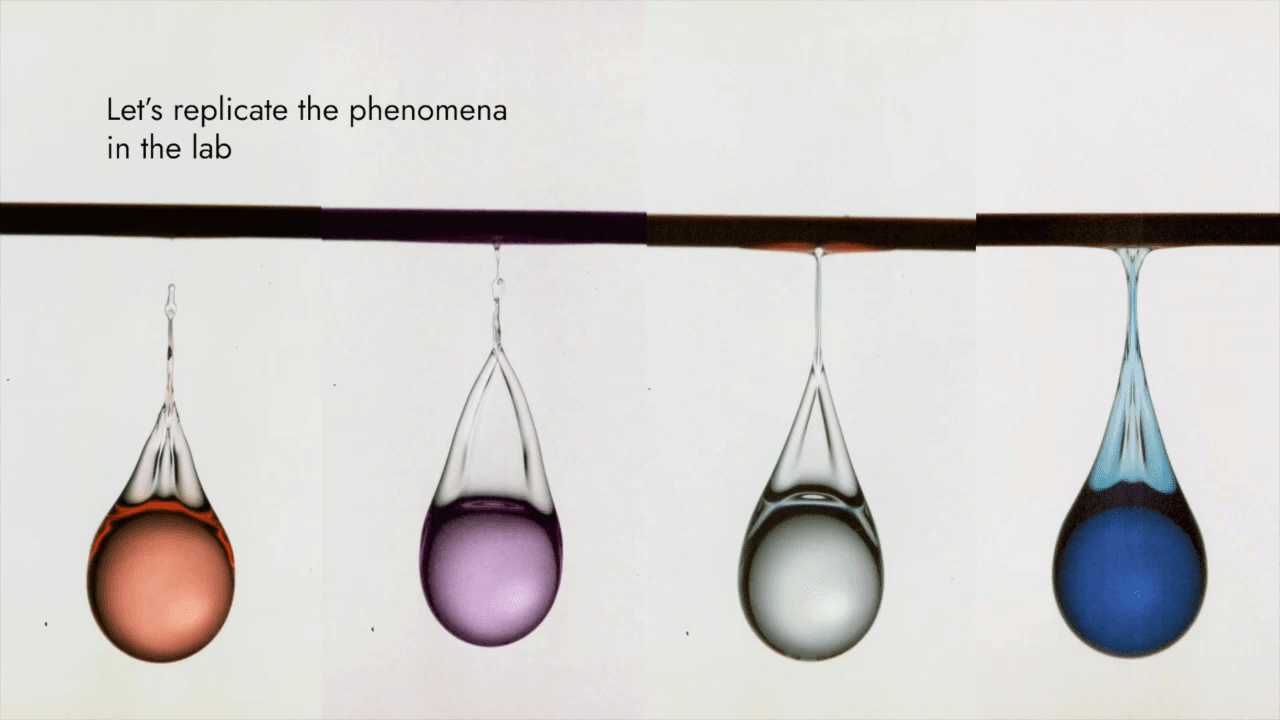
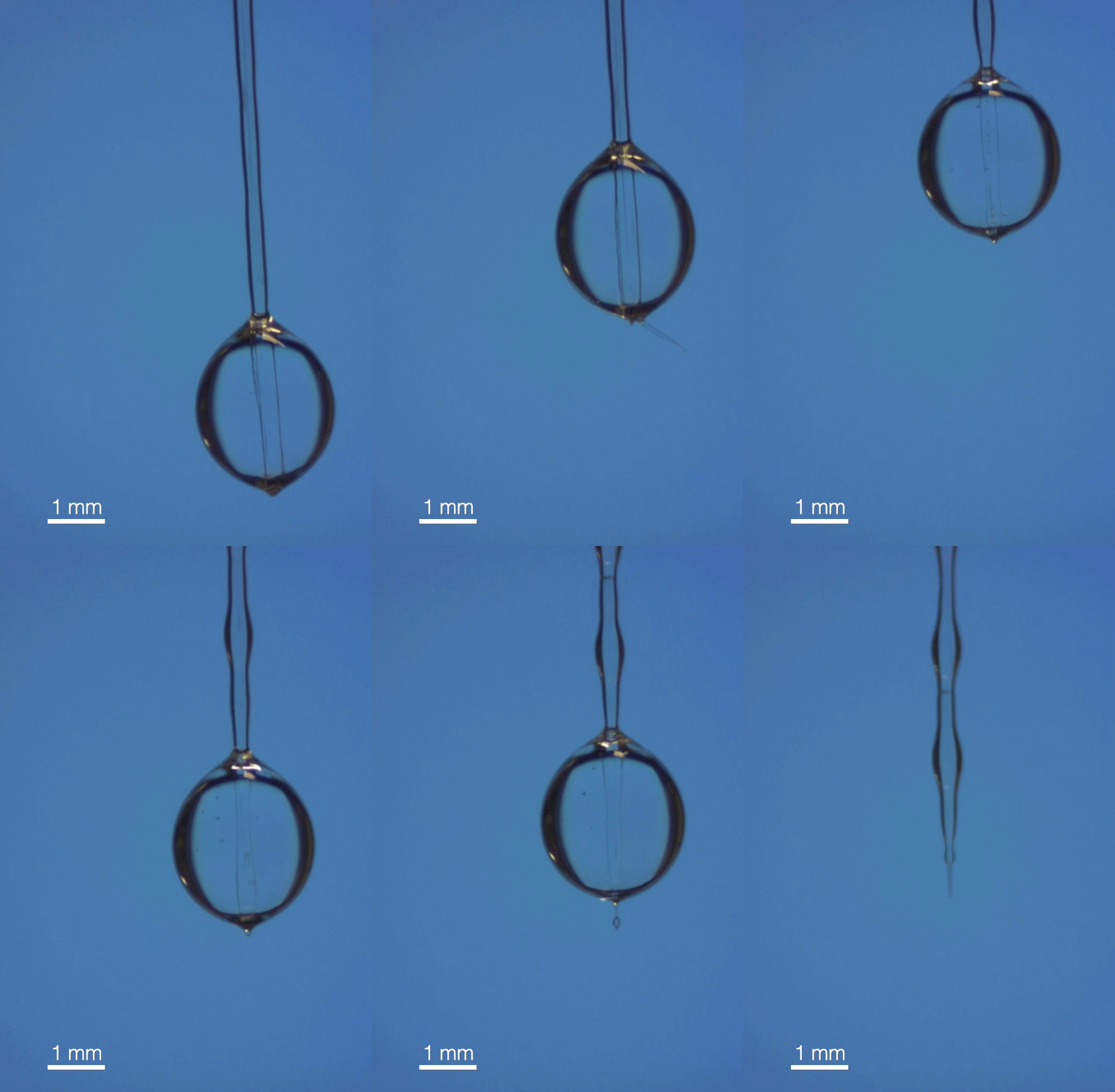
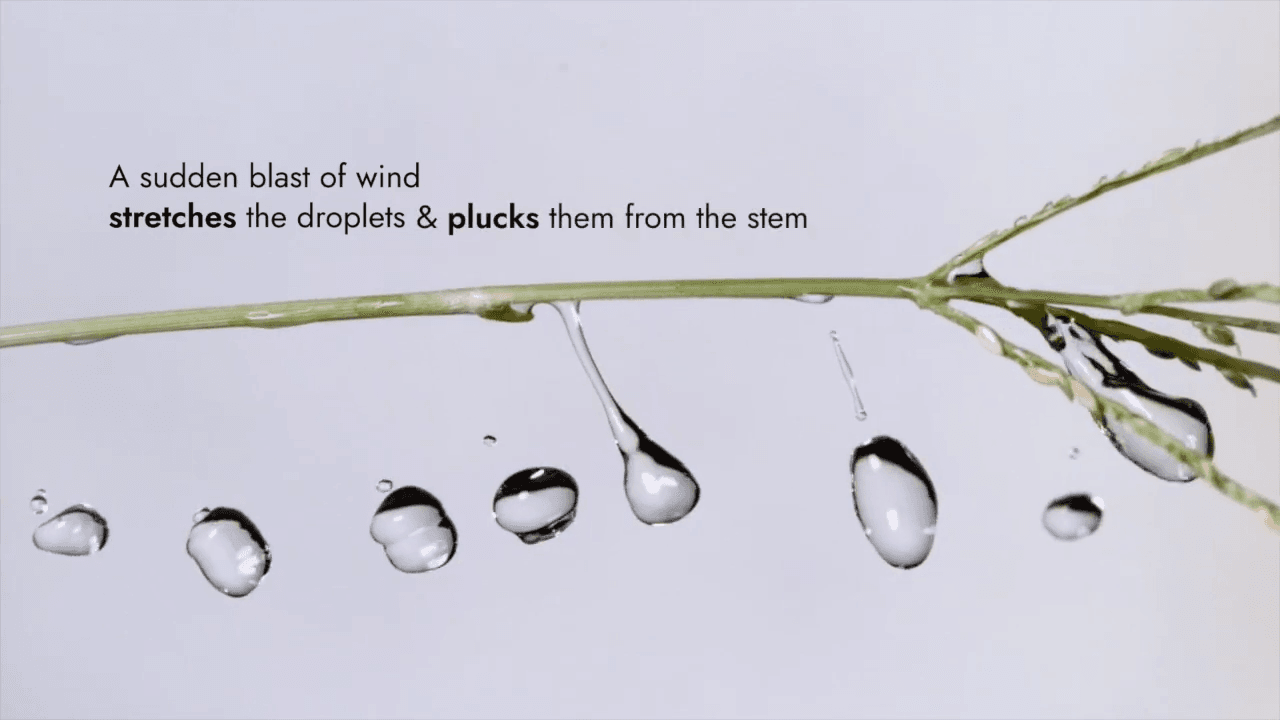
Plucking Droplets
Wind shakes a plant stem, causing droplets to stretch and get plucked away. Text reads,
Composite of four colored droplets being plucked. Text reads,
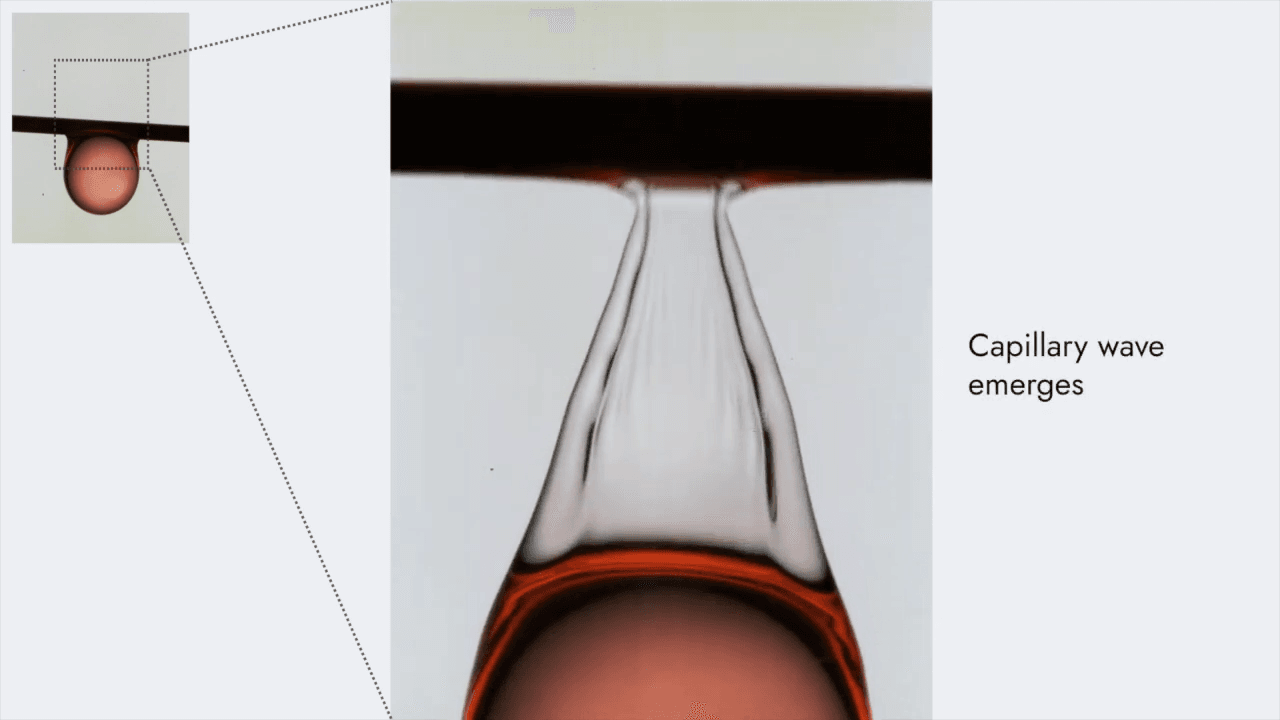
Zoom in on the droplet in the process of breaking away.
Wind shakes a plant stem, causing droplets to stretch and get plucked away. Text reads, "A sudden blast of wind stretches the droplets and plucks them from the stem"Composite of four colored droplets being plucked. Text reads, "LetZoom in on the droplet in the process of breaking away.

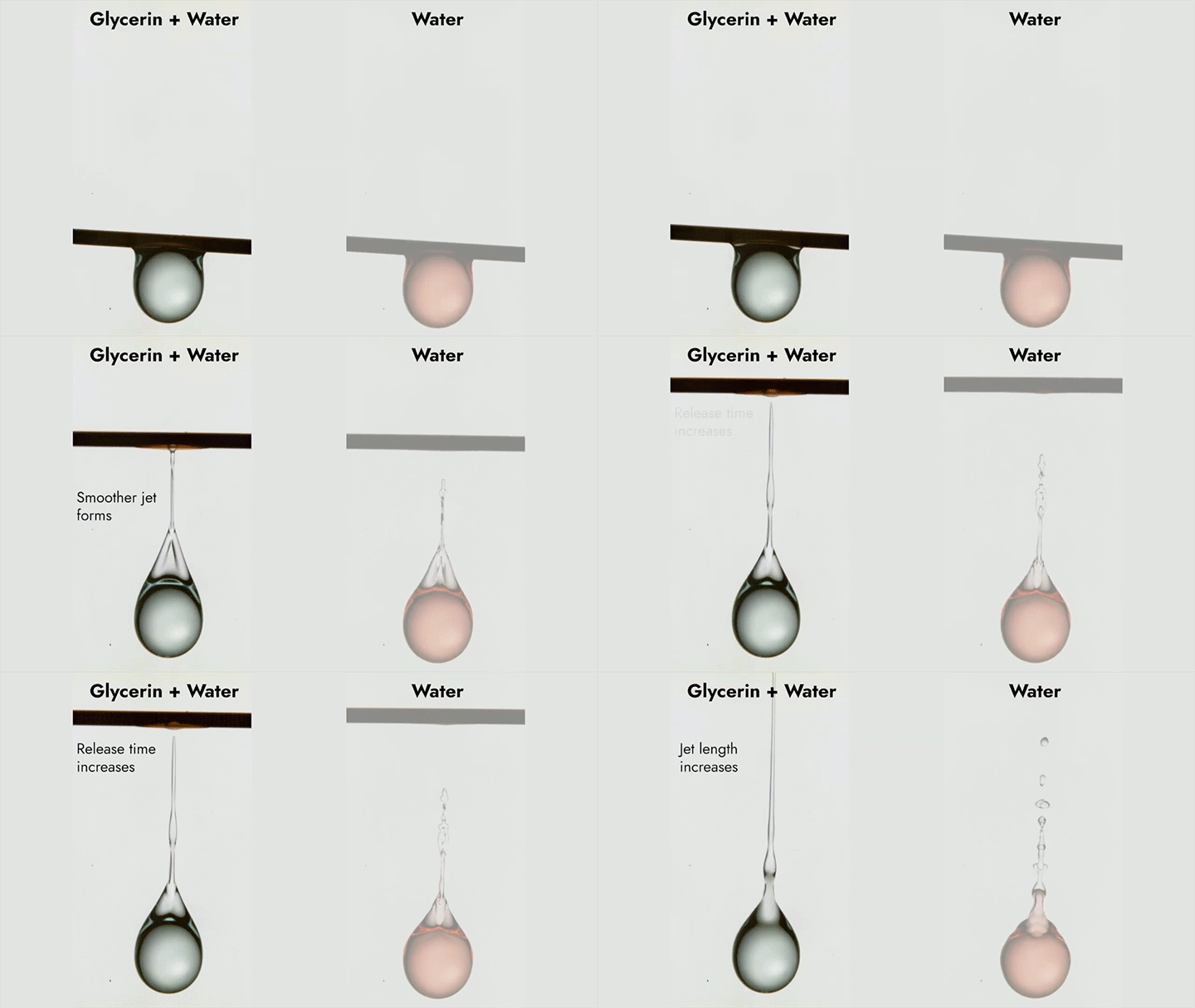
A sudden breeze can pluck droplets hanging from a stem. Here, researchers recreate that phenomenon in the laboratory. With a close-up view and high-speed images, we can enjoy every detail of the detachment and break-up. As the wire pulls away, it drags a liquid sheet off the droplet. The thicker rims on either side of the sheet eventually collide, creating a jet that stretches, deforms, and, at last, breaks. (Video and image credit: D. Maity et al.)

Animation of two droplets getting plucked, one made of glycerin+water (left) and one of water (right).Animation of two droplets getting plucked, one made of glycerin+water (left) and one of water (right). #2025gofm #droplets #flowVisualization #fluidDynamics #physics #science #surfaceTension #viscosity
fyfluiddynamics.com
136
15
90
0
Open post
Nicole Sharp @admin@fyfluiddynamics.com
· 6mo ago
Thunderstorms Make Trees Glow

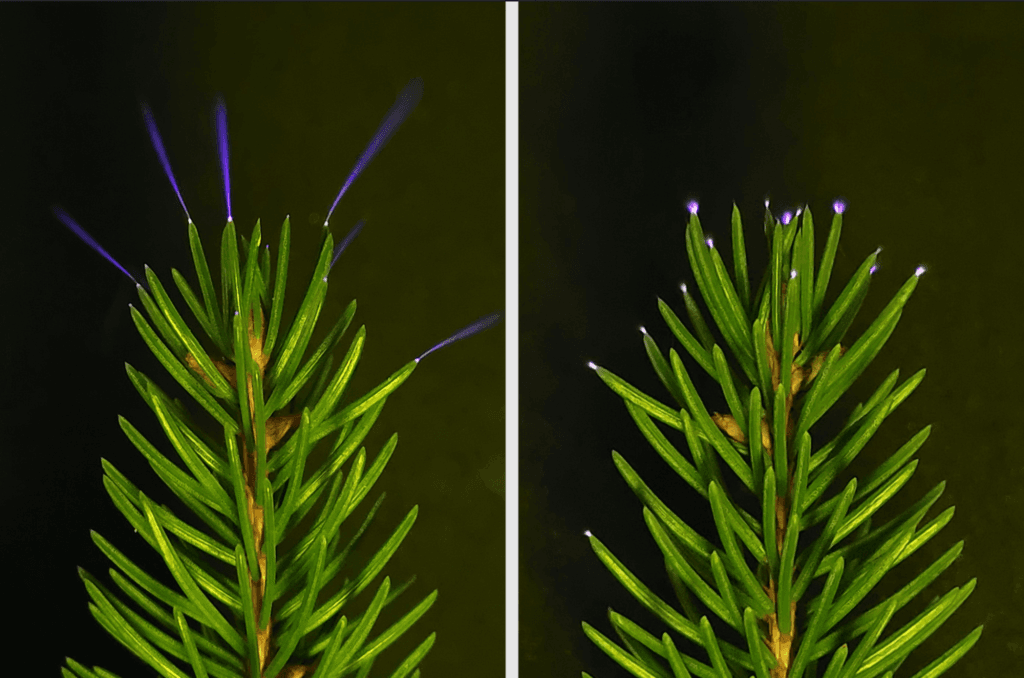
Scientists have long hypothesized that the high electrical charge of thunderstorms could produce an opposite charge in the ground that would discharge from the forest canopy. But this phenomenon, known as a corona, had never been observed on actual trees. A new study, however, has observed this ghostly ultraviolet (UV) glow from the tips of sweetgum leaves and loblolly pine needles during thunderstorms.

Catching these coronae in action required a new kind of UV detector that was ultra-sensitive to the particular band of UV-light emitted by coronas, hot fires, or mercury lamps. Since the latter two weren’t present during the team’s field observations, they were able to conclude that the light they detected came from coronae.

The group observed that corona discharges were transient, jumping from leaf to leaf and branch to branch across the forest canopy. For any creature capable of detecting that glow by eye, it must be incredible to watch the treetops lit by their own ever-shifting auroras during every thunderstorm. (Image credit: W. Brune; research credit: P. McFarland et al.; via SciAm)

A UV corona forms on tree leaves beneath a thunderstorm. #biology #corona #electrohydrodynamics #flowVisualization #fluidDynamics #physics #plasma #science #thunderstorms
doi.org
136
5
90
0
Open post
Nicole Sharp @admin@fyfluiddynamics.com
· 7mo ago
“Broken Water, Like Broken Glass”

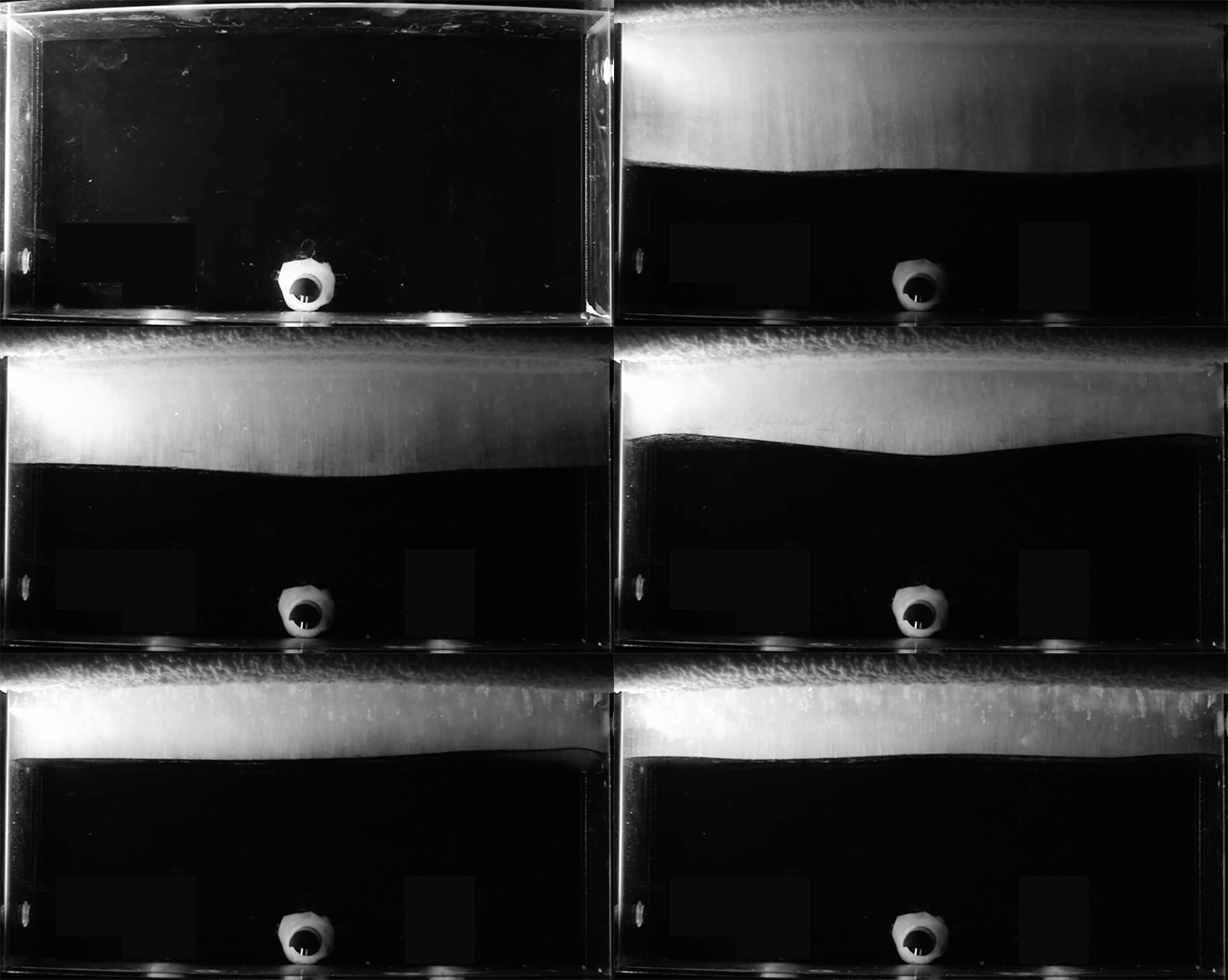
How can you break water? By accelerating it so quickly that the pressure drop forms cavitation bubbles. Here, a steel piston rests against a transparent plate, all underwater. When a hammer strike accelerates the piston away at around 1000g, the severe pressure drop tears the water into bubbles (bottom, left). As the bubbles expand, the nearby piston squishes them into pancakes (bottom, center). As they continue growing, the bubbles press into one another, squeezing thin ridges of water between them. The result (center) resembles broken glass. (Image credit: J. da Silva et al.)

A research poster showing cavitation in water between a plate and piston. #2025gofm #cavitation #flowVisualization #fluidDynamics #physics #science
gfm.aps.org

Gallery of Fluid Motion

136
15
90
0
Open post
Nicole Sharp @admin@fyfluiddynamics.com
· 7mo ago
Milano Cortina 2026: Ski Jumping Suits

Ski jumping is in the news this Olympic cycle after rumors that male competitors may be cheating in order to wear larger suits. In particular, the suggestion is that male athletes are injecting fillers into their genitals before their pre-season 3D body scan in order to appear large enough to allow them to wear a larger suit. This comes after two Norwegian ski jumpers were punished for illegally restitching the crotches of their suits to make them larger.

Ski jumping is a sport that relies heavily on aerodynamics; during the flight phase, jumpers try to maximize their lift-to-drag ratio so that they stay aloft as long as possible. A 2025 study underscores the importance of suit size in this calculus. In the work, the researchers used a baseline suit that was 4 centimeters larger in circumference than their jumper–the loosest configuration that regulations allow. They compared that suit’s flight performance (in wind tunnels and simulation) to a suit 2 cm larger and one 2 cm smaller. The extra 2 centimeters of circumference made a notable difference: the larger suit increased the drag by ~4% and lift by ~5%. That was enough, in their simulation, to let a jumper fly an extra 5.8 meters.

It’s worth noting, though, that the study was looking at the effects of adjusting the suit’s circumference along the entire length between the arm pits and the knees; they never changed anything about the suit’s crotch. I don’t think there’s enough scientific data to say that packing a bit more there would really offer aerodynamic advantages. And the risks of such injections are non-negligible. (Image credit: T. Trapani; research credit: M. Virmavirta et al.; via Ars Technica)

A ski jumper in flight, viewed from behind. #aerodynamics #fluidDynamics #milanocortina2026 #Olymipcs #physics #science #skiJumping #WinterOlympics
nytimes.com
136
15
90
0
Open post
Nicole Sharp @admin@fyfluiddynamics.com
· 8mo ago
A Drop of Algae

Spheres of a Volvox colonial algae glow green inside a droplet in this award-winning microphotograph by Jan Rosenboom. Pinned on an inclined surface, the droplet is frozen in a balance between gravity and surface tension that keeps its shape–and its contact angles–asymmetric. Droplets will also take on a shape similar to this when air is blowing past them. (Image credit: J. Rosenboom; via Ars Technica)

#biology #contactLine #droplets #fluidDynamics #fluidsAsArt #science #sessileDrop
gfm.aps.org

Gallery of Fluid Motion

136
15
90
0
Open post
Nicole Sharp @admin@fyfluiddynamics.com
· 7mo ago
Boosted by @cstross@wandering.shop
Richtmyer-Meshkov Instability If you send a shock wave through a magnetized plasma–something that happens in both supernova explosions and inertial confinement fusion–it can trigger an instability known as the Richtmyer-Meshkov instability. The image above shows a form of this, taken from a simulation. Rather than treating the plasma as a single idealized fluid, the researchers represented it as two fluids: an ion fluid and an electron fluid. This allowed them to better capture what happens when certain components of the plasma react to changes faster than others do. The image itself shows the electron number density across the fluid, where darker colors represent higher electron number density. The interface between high and low-densities shows a roll-up instability that resembles the Kelvin-Helmholtz instability, but there are also regions of mushroom-like plumes that more closely resemble Rayleigh-Taylor instabilities. The authors note that these structures don’t appear in simulations that represent a plasma as a single fluid; you need the two-fluid representation to see them. (Image and research credit: O. Thompson et al.) #CFD #computationalFluidDynamics #fluidDynamics #instability #KelvinHelmholtzInstability #magnetohydrodynamics #numericalSimulation #physics #plasma #RayleighTaylorInstability #RichtmyerMeshkovInstability #science #shockwave
gfm.aps.org
70
15
27
0
Open post
Nicole Sharp @admin@fyfluiddynamics.com
· 7mo ago
A Bubbly Heart

Next time you fill your water bottle, watch closely and see if you can spot a bubble heart like these. When a jet falls into a pool, it pulls air in with it. The low pressure of the jet pulls bubbles inward, even as shear pulls the bubbles downward with the sinking liquid. If the bubbles are large and there’s enough momentum in the jet, the lower portion of the bubble will get pulled into a conical shape, while the upper portion remains a hemisphere. That forms one lobe of the heart. The other half requires a second bubble. But with a little patience and luck, you can form a complete heart. Happy Valentine’s Day! (Image credit: S. Tuley et al.)

#2025gofm #bubbles #fluidDynamics #fluidsAsArt #jets #physics #science #surfaceTension
gfm.aps.org
70
3
27
0
Open post
Nicole Sharp @admin@fyfluiddynamics.com
· 5mo ago
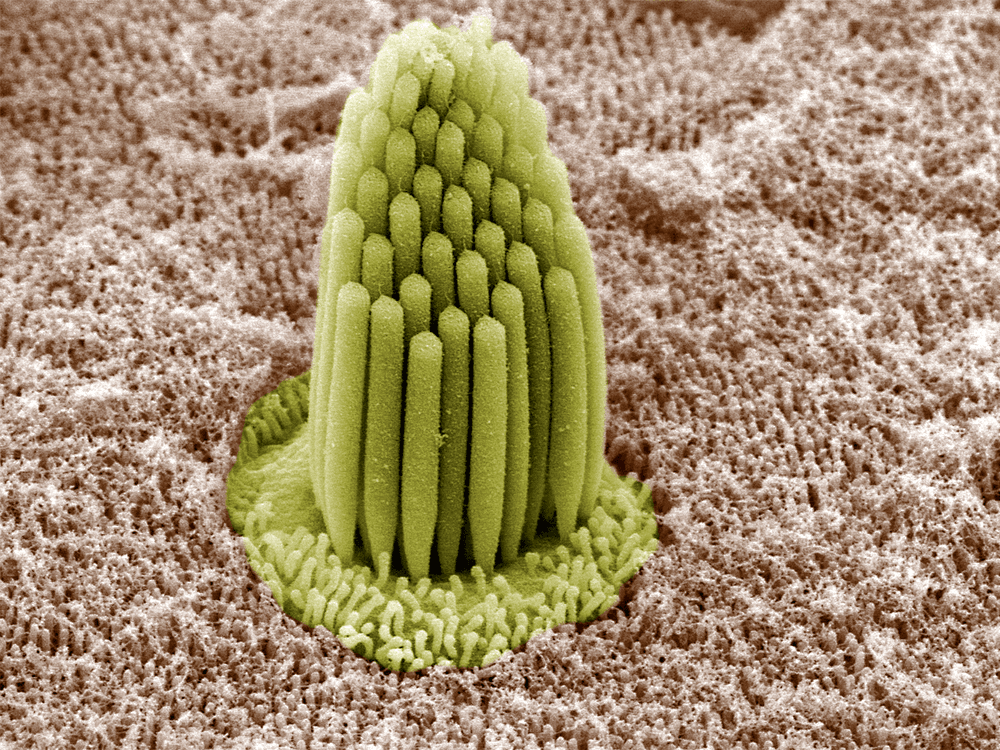
Inside an Ear

Our ears, like those of many other animals, convert mechanical signals to electrical ones, through a Rube-Goldberg-esque series of transformations. External sound waves make their way down the soft tube of the ear canal, which funnels them to a thin-walled cone, the eardrum, that’s about half as large as a dime. Here, the vibrating air pushes against the cone’s membrane, and those vibrations travel onward through a linked trio of small bones that amplify the vibration’s amplitude.

The last of these bones presses against an even smaller, oval-shaped membrane. As the bone moves, it shakes the membrane, sending waves through the liquid on its other side. Those waves travel down the spirals of the tiny, pea-sized cochlea, named for a snail shell’s shape. As the waves move through the liquid, they bend bundles of hair-like strands back and forth, like tall grass waving in a breeze. The bending triggers a chemical that binds to nerves at the base of the bundles, sending an electrical signal through the nerve and into the brain.

But the hair-like bundles, known as stereocilia, are also able to amplify incoming vibrations. In this case, the bundles in the outer portion of the cochlea expend energy to bend more than the incoming vibrations naturally make them move. This bending amplifies the fluid motion that gets transmitted to stereocilia further down the line; it’s those bundles that will make the final conversion to an electrical signal the brain receives. (Image credit: B. Kachar; research credit: Y. Thipmaungprom et al.; via APS)

Scanning electron microscope view of the stereocilia Scanning electron microscope view of the stereocilia “hair bundles” inside a frog’s inner ear. #acoustics #biology #cilia #fluidDynamics #physics #science #vibration
en.wikipedia.org
25
1
23
0
Open post
Nicole Sharp @admin@fyfluiddynamics.com
· 6mo ago
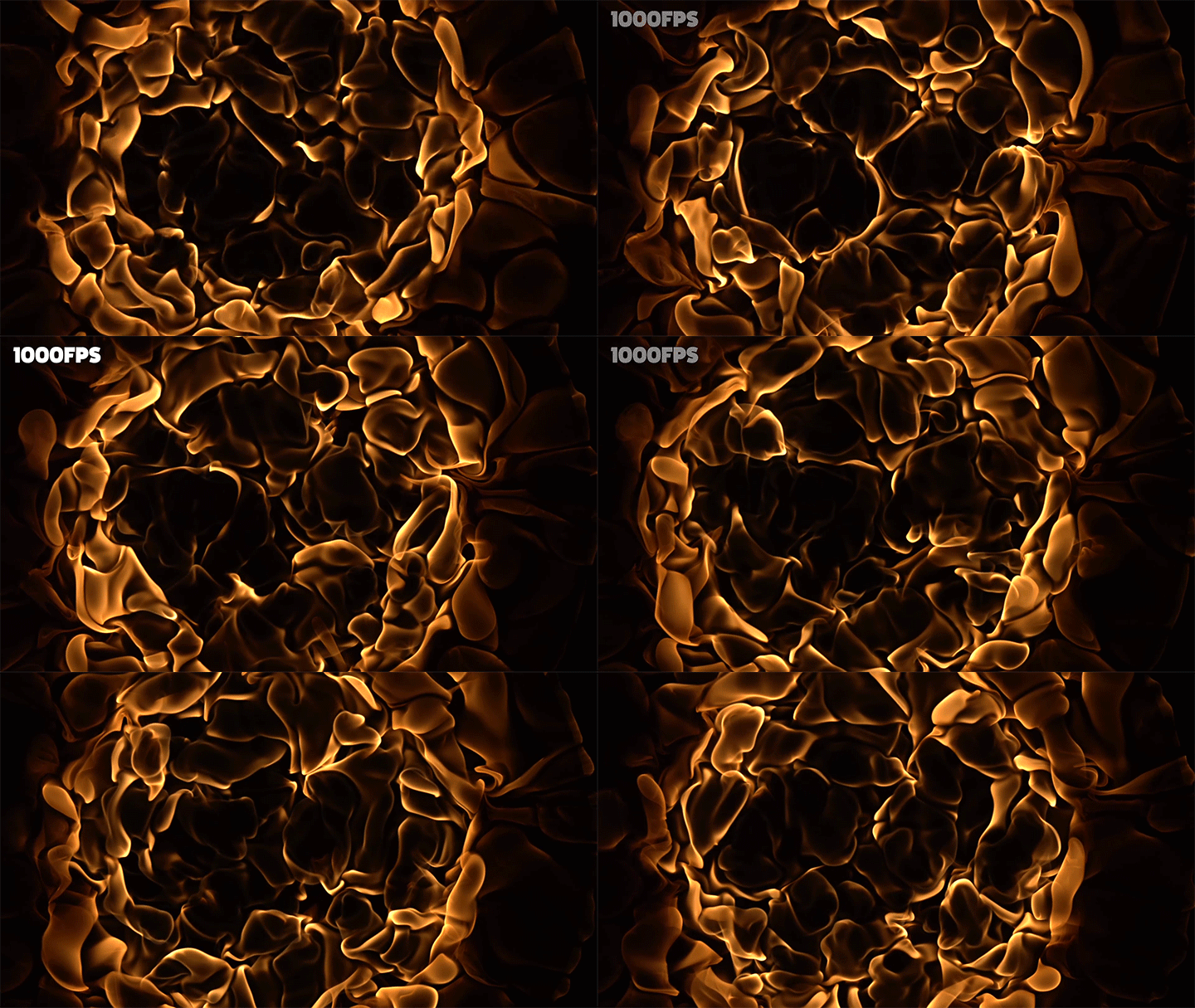
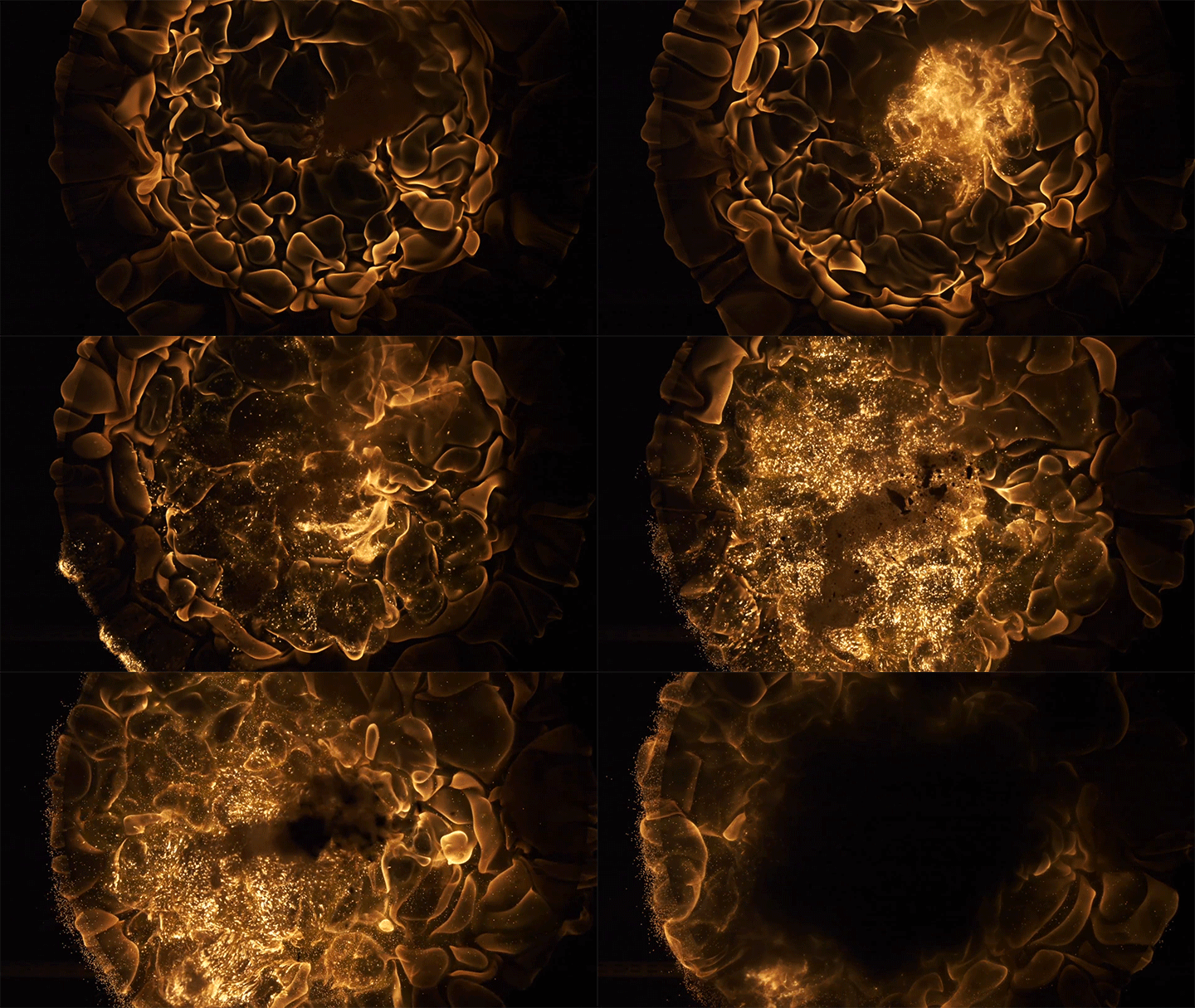
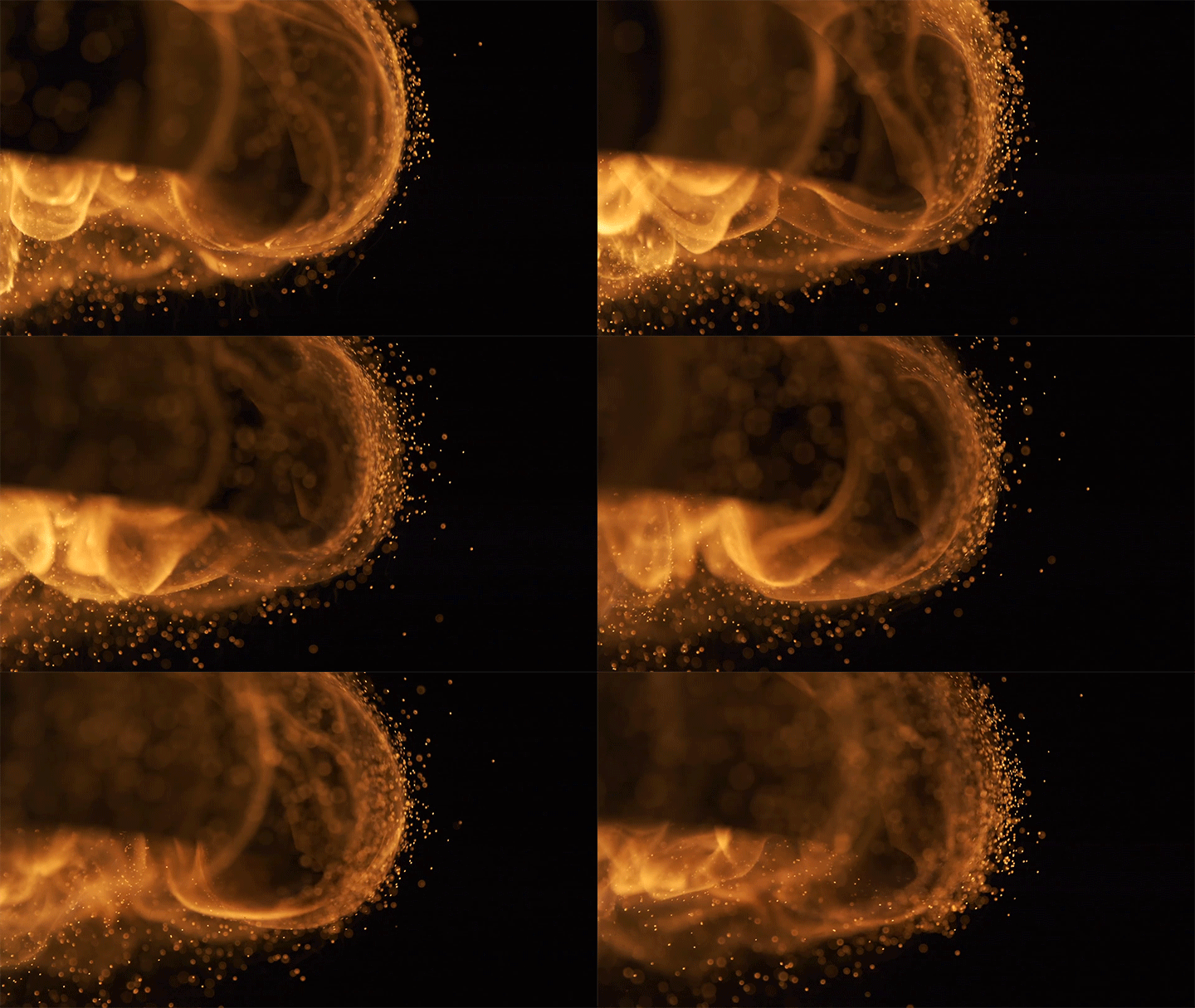
Fire From Below
A burning fire viewed from below in high-speed footage.
A burning fire viewed from below in high-speed footage. The sparks are ground cinnamon tossed into the flames.
Fire (spiked with ground cinnamon sparks) flowing up and over a rounded edge.
A burning fire viewed from below in high-speed footage.A burning fire viewed from below in high-speed footage. The sparks are ground cinnamon tossed into the flames.Fire (spiked with ground cinnamon sparks) flowing up and over a rounded edge.

A slight change in perspective can do wonders. In this video, the Slow Mo Guys look at a burning flame from below. They accomplish this by mounting a gas grill upside-down. This small change means that buoyancy can’t simply lift heat and exhaust gases away from the flame source. Instead, the flow pushes out and around the edges of the grill.

The views are, as always, amazing. The billowing flames are mesmerizing–often closer to laminar than turbulent. And the added spectacle of cinnamon combusting in the later segments really does make for the kind of visuals you’d expect in a sci-fi movie. (Video and image credit: The Slow Mo Guys)

#buoyancy #combustion #fire #flame #flowVisualization #fluidDynamics #fluidsAsArt #physics #science
fyfluiddynamics.com
9
0
6
0
Open post
Nicole Sharp @admin@fyfluiddynamics.com
· 6mo ago
Making a Star-Shaped Droplet

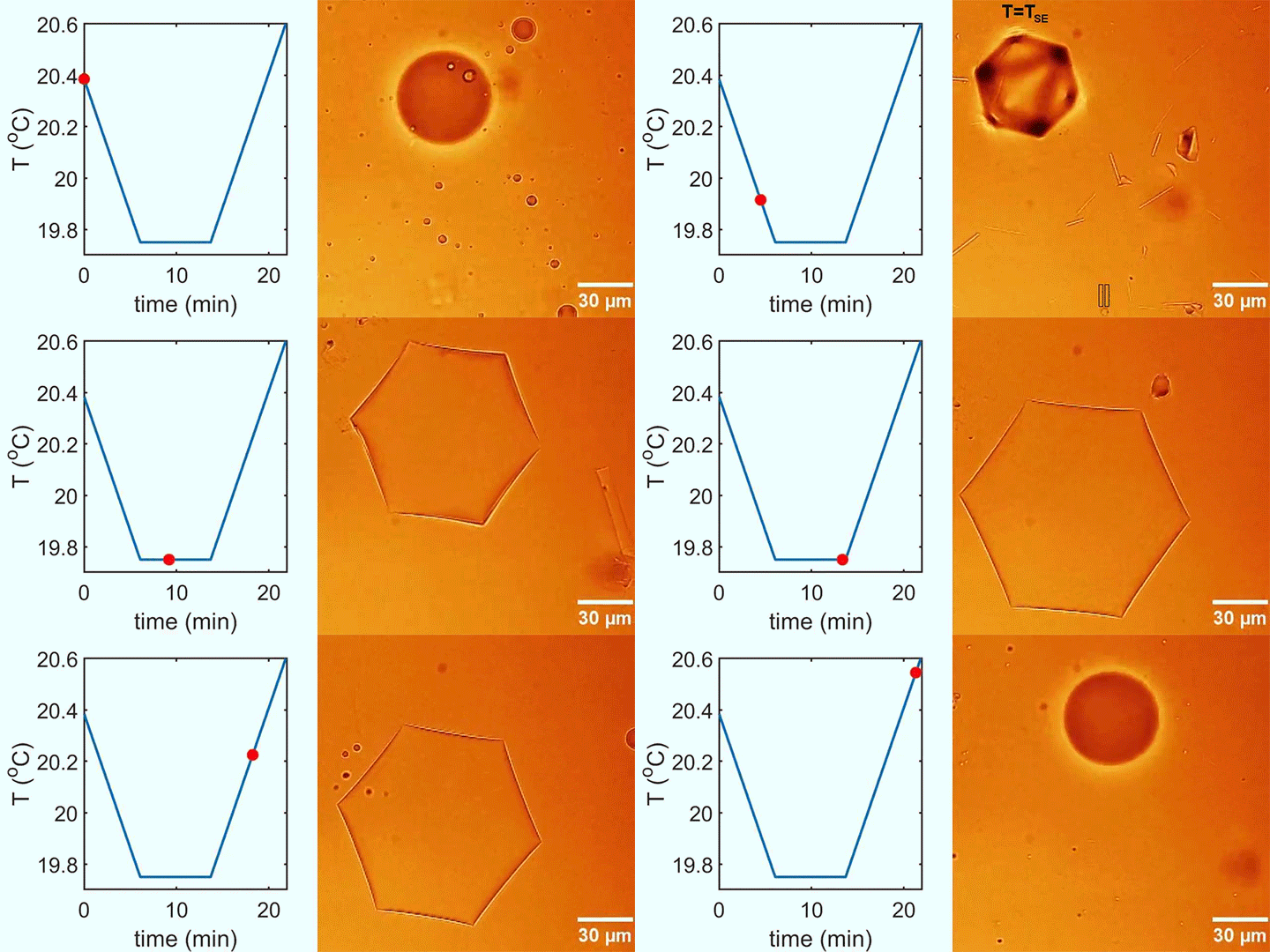
We usually think of surface tension turning droplets into spheres in order to minimize their area. But spheres aren’t the only shape surface tension can enforce. Here, researchers suspend tiny droplets of oil in a soapy fluid. At the right temperature, these droplets form a crystalline surface while the fluid within remains liquid. As in the fully liquid droplet, surface tension tries to minimize the shell’s surface energy, enabling it to take on many different shapes.

Video showing the droplet's transition from hexagon to star and back. The shape changes occur as the liquid's temperature changes, thereby affecting its surface tension.The droplet’s transition from hexagon to star and back. The shape changes occur as the liquid’s temperature changes, thereby affecting its surface tension.

In this study, researchers demonstrate that the shell-enclosed droplets can even change, reversibly, from a hexagon to a six-pointed star and back. The transformation is shown above, in an experiment that gradually changes the droplet’s temperature–and, thus, its surface tension.

Although shape changes similar to these have been described before, this experiment was the first where the shell’s defects–the vertices of the hexagon–don’t shift during the transformation. (Video, image, and research credit: C. Quilliet et al.; via APS)

#droplets #fluidDynamics #physics #science #surfaceTension
doi.org
9
0
6
0
Open post
Nicole Sharp @admin@fyfluiddynamics.com
· 6mo ago
Bioconvection

Convection isn’t always driven by temperature. Here, researchers explore the convective patterns formed by Thiovulum bacteria. These bacteria are negatively buoyant, meaning they will sink if they aren’t swimming. They also have an asymmetric moment of inertia, so any flow moving past them tends to affect their swimming direction.

When let loose in a Hele-Shaw cell with a oxygen levels that decrease with depth, the bacteria create complex convection-like patterns. They swim slowly upward in wide, slow plumes and sink in denser, narrow plumes. In other areas, they form large-scale rotating vortices. (Video and image credit: O. Kodio et al.)

#2025gofm #bioconvection #biology #convection #flowVisualization #fluidDynamics #physics #science
gfm.aps.org
8
0
5
0
Open post
Nicole Sharp @admin@fyfluiddynamics.com
· 6mo ago
Bursting Bubbles

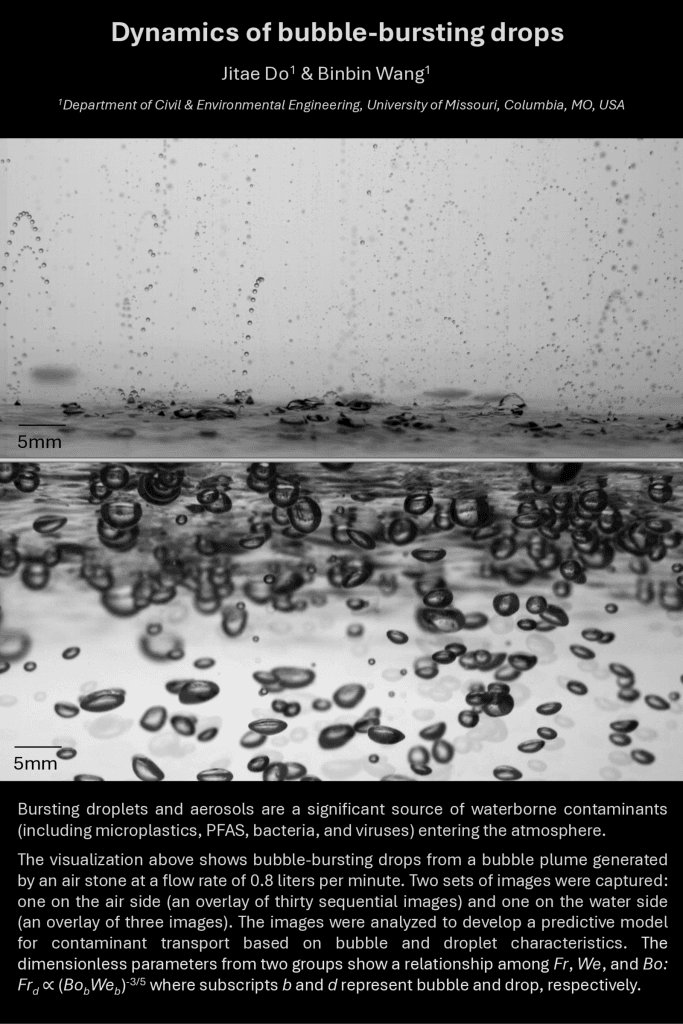
When air bubbles rise through a liquid, they scavenge dust, viruses, microplastics, and other impurities as they go. Once at the surface, these contaminant-covered bubbles thin and burst, generating many tiny droplets that arc through the air above. You’re likely familiar with the sight and sensation from a glass of champagne or soda.

Here, researchers have stacked two sets of sequential images to illustrate this complicated flowscape. Under the surface, a trio of photos are stacked to show bubbles rising and gathering at the surface. In the air, the researchers have stacked thirty sequential images, which together trace out the parabolic arcs of droplets sprayed by the bursting bubbles. (Image credit: J. Do and B. Wang)

A research poster showing composite images of bubbles rising to a water-air interface and bursting, sending up a spray of microdroplets. #2025gofm #bubbles #bursting #droplets #flowVisualization #fluidDynamics #physics #science
gfm.aps.org
6
14
6
0
Open post
Nicole Sharp @admin@fyfluiddynamics.com
· 6mo ago
Aging Salty Ice

When ice forms in salty water, it starts out mushy and porous. Salt does not freeze neatly into ice’s crystalline structure, so the forming ice has pores and gaps where salty brine gathers. As the ice ages, more brine is pushed out and gradually convects downward, due to its greater density. Over time, this makes the ice layer thinner but more solid, with fewer pores. You can see a timelapse of the process in a laboratory experiment below. (Image credit: sea ice – C. Matias, experiment – F. Wang et al.; research credit: F. Wang et al.)

Timelapse of ice forming and aging in salt water over the course of ~16 days. #convection #fluidDynamics #freezing #ice #iceFormation #physics #porosity #porousFlow #science #seaIce
unsplash.com
7
2
5
0
Open post
Nicole Sharp @admin@fyfluiddynamics.com
· 6mo ago
“Arctic Fox in Blizzard”

A blue arctic fox bears the wind and snow of a Norwegian blizzard in this image by photographer Klaus Hellmich. The wind is strong enough to move snowflakes several centimeters in the time the camera’s shutter is open. This leaves the image full of streaklines that reveal the paths taken by the wind and snow. This visualization technique is useful in the lab, too. (Image credit: K. Hellmich; via Colossal)

#flowVisualization #fluidDynamics #fluidsAsArt #physics #science #streaklines
worldphoto.org
7
5
5
0
Open post
Nicole Sharp @admin@fyfluiddynamics.com
· 6mo ago
Explaining the Swirl of Wildfire Smoke

In recent years, smoke from powerful wildfires has raised questions among atmospheric scientists by always swirling in the same direction. The confounding structures were observed in the stratosphere, where smoke injected at around 15 kilometers in altitude absorbed sunlight and rose further, up to about 35 kilometers of altitude. The rising column of fluid would stretch, causing any residual rotation to get stronger and form vortices.

None of this was a surprise. What was surprising is that all of the observed vortices were anticyclones, when theory–at least for a heat-driven vortex from a stationary heating source–called for a cyclone-anticyclone pair.

Researchers looked at how a self-heating (and, therefore, moving) source would rotate. They concluded that this, too, would create a pair of vortices–one cyclonic and one anticyclonic–but the anticyclone would be stronger than the cyclone that trailed behind it. By further considering the vertical shear the vortex pair would encounter, the researchers found that the trailing cyclone could get stripped away, leaving behind only the anticyclone–matching our wildfire observations. (Image credit: J. Stevens/NASA Earth Observatory; research credit: K. Shah and P. Haynes 1, 2; via APS)

#anticyclone #atmosphericScience #cyclone #fluidDynamics #physics #science #vortices #vorticity #wildfires
doi.org
5
13
3
0
Open post
Nicole Sharp @admin@fyfluiddynamics.com
· 6mo ago
Glacial Blues

Meltwater braids like a river delta in this gorgeous image from photographer Stuart Chape. It earned the Silver distinction from the World Nature Photography Awards in their “Planet Earth’s landscapes and environments” category. Water takes tortuous paths like these as it tries to balance the local incline, erosion, deposition, and flow rate. (Image credit: S. Chape/WNPA; via Colossal)

#fluidDynamics #fluidsAsArt #glacier #meander #physics #riverDelta #science
worldnaturephotographyawards.com
4
15
2
0
Open post
Nicole Sharp @admin@fyfluiddynamics.com
· 6mo ago
Turbulence and Bioluminescence

If you’ve ever seen crashing waves glowing blue, you’ve been treated to bioluminescence. Although many creatures can bioluminesce, tiny dinoflagellates–a type of marine phytoplankton–are one of the easiest to spot. These microscopic organisms create a flash of light in response to viscous stresses. Their response to flow-induced stresses is so robust that they can be used to visualize stress fields.

In a new study, researchers explored how turbulence affects the dinoflagellate’s luminescence. They mathematically modeled the dinoflagellate as an elastic dumbbell that emitted light based on its extent and rate of deformation. Then they explored how this model dinoflagellate behaved in different types of turbulent flows. They found that the fluctuations and intermittency of turbulent flows both encouraged the radiant displays. (Image credit: T. McKinnon; research credit: P. Kumar and J. Picardo)

#biology #bioluminescence #flowVisualization #fluidDynamics #physics #phytoplankton #science #turbulence
ieeexplore.ieee.org
4
13
2
0
Open post
Nicole Sharp @admin@fyfluiddynamics.com
· 7mo ago
Connecting Canals

Before the rise of railroads, canals provided critical commercial shipping infrastructure for many locations worldwide. But connecting canals at different elevations required locks–sometimes a whole series of them–as in the case of Scotland’s Union Canal and the Forth and Clyde Canal. In the canals’ heyday, navigating the 11 locks between them took the better part of a day–one of many reasons that canals fell out of use over time.

When Scotland decided to reconnect the canals in the 1990s, they picked a very different solution for this elevation challenge: the Falkirk Wheel. Grady walks us through the clever engineering of this impressive piece of infrastructure in this Practical Engineering video. (Video and image credit: Practical Engineering)

#canals #civilEngineering #engineering #fluidDynamics #locks #physics #science
en.wikipedia.org
5
15
6
0
Open post
Nicole Sharp @admin@fyfluiddynamics.com
· 7mo ago
Inside Cepheid Variable Stars

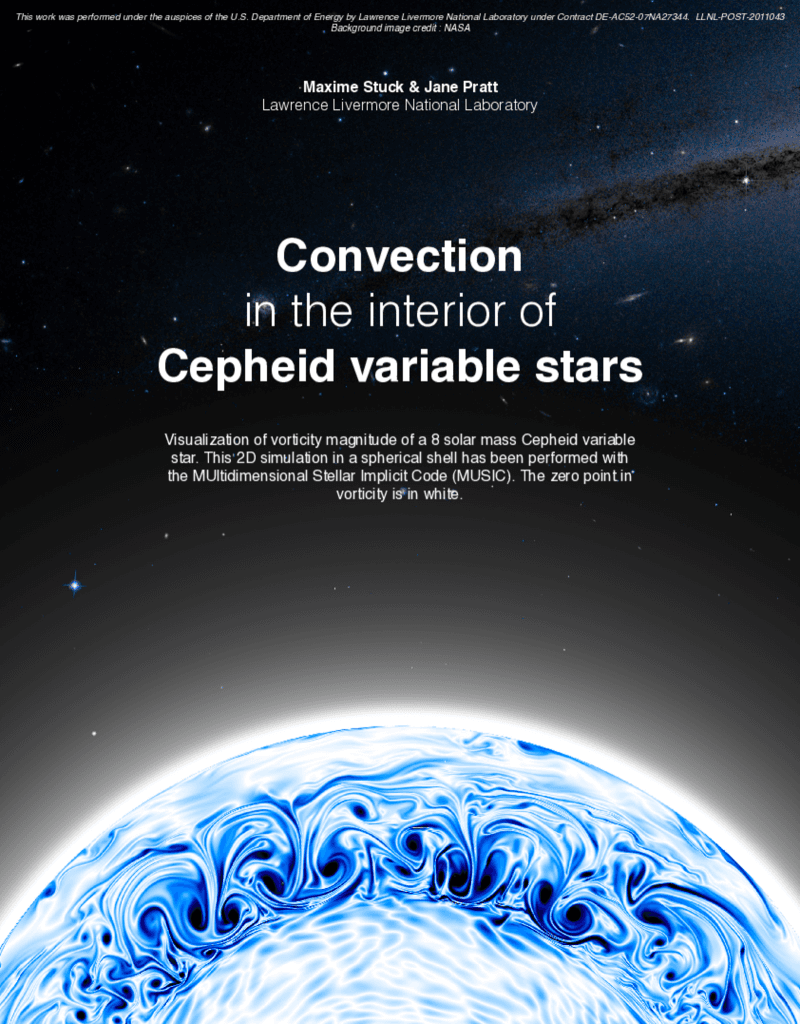
Cepheid variable stars pulsate in brightness over regular periods. That’s one reason astronomers use them as a standard candle to judge distances–even for stars well outside our galaxy. In this image, researchers display a simulation of convection inside a Cepheid eight times more massive than our sun. The colors represent vorticity, with zero vorticity in white.(Image credit: M. Stuck and J. Pratt)

A research poster showing a simulation of convection inside a Cepheid variable star with 8 solar masses. #2025gofm #astrophysics #CFD #computationalFluidDynamics #convection #flowVisualization #fluidDynamics #numericalSimulation #physics #science
en.wikipedia.org
5
15
7
0
Open post
Nicole Sharp @admin@fyfluiddynamics.com
· 7mo ago
Milano Cortina 2026: How Ski Skins Work Image of climbing skins on a set of touring skis.

The 2026 Olympics include the debut of ski mountaineering (a.k.a. skimo), a sprint race heading both up and down the mountain on skis. During the uphill segment of the race, competitors use skins on their skis to help them climb; these skins then get ripped off (see below) before skiing back down.

Animation of a racer pulling the skins off their skis in a transition.

As their name suggests, the first climbing skins used on skis were made from seal skin. By angling the seal fur, skiers could glide in the forward direction and resist sliding backwards. Modern skins may have animal or synthetic fibers, but they use the same physical mechanism. The angled hairs let skis slide forward easily, then grip and resist sliding backward. (Image credits: touring – H. Morkel, skins – Josefka, video – NBC Bay Area)

#fluidDynamics #hairySurfaces #milanocortina2026 #olympics #physics #science #skiing
5
15
4
0
Open post
Nicole Sharp @admin@fyfluiddynamics.com
· 7mo ago
Understanding Schlieren
With a schlieren system, we can see an invisible gas poured from one beaker to another.
This ray diagram shows how the spherical mirror used in this schlieren set-up reflects light.
A vortex ring made of carbon dioxide--and its reflection.
With a schlieren system, we can see an invisible gas poured from one beaker to another.This ray diagram shows how the spherical mirror used in this schlieren set-up reflects light.A vortex ring made of carbon dioxide--and its reflection.

Schlieren techniques are one of my favorite forms of flow visualization. They cleverly make the invisible visible through an optical set-up that’s sensitive to changes in density. They’re great–as seen in the examples here–for seeing local buoyant flows like the plumes that rise from a candle, or for making gases like carbon dioxide visible. They’re also excellent for visualizing shock waves.

In this video, physicist David Jackson explains how one particular flavor of schlieren–one using a spherical mirror–works. There are lots of other possible schlieren set-ups, too, though each one has its quirks. (Video and image credit: All Things Physics; submitted by David J.)

#DIYFluids #flowVisualization #fluidDynamics #physics #schlierenPhotography #science
fyfluiddynamics.com
4
15
2
0
Open post
Nicole Sharp @admin@fyfluiddynamics.com
· 7mo ago
Improving Turbulence Models

Calculating turbulent flows like those found in the ocean and atmosphere is extremely expensive computationally. That’s why forecasting models use techniques like Large Eddy Simulation (LES), where large physical scales are calculated according to the governing physical equations while smaller scales are approximated with mathematical models. Researchers are always looking for ways to improve these models–making them more physically accurate, easier to compute, and more computationally stable.

In a new study, researchers used an equation-discovery tool to find new improvements to these models for the smaller turbulent scales. They started by doing a full, computationally expensive calculation of the turbulent flow. The equation-discovery tool then analyzed these results, looking to match them to a library of over 900 possible equations. When it found a form that fit the data, the researchers were then able to show analytically how to derive that equation from the underlying physics. The result is a new equation that models these smaller scales in a way that’s physically accurate and computationally stable, offering possibilities for better LES. (Image credit: CasSa Paintings; research credit: K. Jakhar et al.; via APS)

#CFD #computationalFluidDynamics #fluidDynamics #geophysics #largeEddySimulation #machineLearning #mathematics #numericalSimulation #physics #science #turbulence
en.wikipedia.org
2
13
1
0
Open post
Nicole Sharp @admin@fyfluiddynamics.com
· 2mo ago
Giant Water Balloon to the Face

It’s the summertime, so Gav and Dan of the Slow Mo Guys are back to experimenting with giant water balloons. In this video, they send several careening down a slope into Dan’s face. Watching the balloons descend and pop is (unsurprisingly) my favorite part. It’s neat to see how the elasticity of the balloon acts like a beefed-up surface tension to make this enormous blob of water act like an oversized droplet. (Video and image credit: The Slow Mo Guys)

#fluidDynamics #inertia #physics #science #surfaceTension #waterBalloons
fyfluiddynamics.com
0
0
0
0
Open post
Nicole Sharp @admin@fyfluiddynamics.com
· 2mo ago
Múlajökull

Iceland’s Múlajökull glacier is prone to sudden surges, where rapid ice flow is interspersed between periods of quiescence or retreat. The isolated nature of the glacier and its marshy surroundings make approaching on foot almost impossible, but photographer Dani Guindo captured gorgeous aerial images of the glacier’s many rivulets ribboning about the landscape it’s carved. (Image credit: D. Guindo; via Colossal)

#fluidDynamics #geophysics #glacier #instability #meander #physics #rivers #science
en.wikipedia.org
0
0
0
0
Open post
Nicole Sharp @admin@fyfluiddynamics.com
· 3mo ago
Closing a Venus Fly Trap

The Venus fly trap has long fascinated scientists with its ability to catch fast-moving prey. Just how the plant closes its “trap” leaf so quickly is a matter of debate. A new study gives us more detail–but not complete clarity–about what’s going on.

One way that plants move rapidly is by moving water into or out of cells, changing their internal pressure. The new experiments showed that this is not what the fly trap does. Specifically, by watching the speed at which individual Venus fly trap cells take up water, the team concluded that closing the leaf would take 30-150 seconds–far more than the 1 second observed.

Instead, the team showed that the trap’s rapid closure happens because the plant’s cell walls rapidly soften, making the leaf unable to stay open against previously-stored elastic energy. Instead, the trap snaps closed. The physical mechanism behind the softening is still unclear, though, so the charismatic plant still has mysteries for us to discover. (Image credit: N. Suzuki; research credit: J. Ryu et al.; via Nature and Gizmodo)

#biology #fluidDynamics #physics #plants #science #turgorPressure #venusFlyTrap
doi.org
0
0
0
0
Open post
Nicole Sharp @admin@fyfluiddynamics.com
· 2mo ago
Droplets Can Climb Sugar Fibers

In nature, droplets and fibers can meet on a spider’s web, on fur, or on a dew-gathering cactus. Here, researchers explore what happens when the droplet can dissolve the fiber it’s suspended on. As the authors note, a lumberjack who cuts the branch they sit on makes a fatal choice. The droplet sees a different outcome.

As the droplet hangs on the fiber, it dissolves the fiber’s sugar. Dense, sugar-laden water flows downward along the fiber and a replenishing upward flow goes along the droplet’s exterior. Because the sugar concentration is lower near the top of the drop, the fiber thins most quickly there.

A droplet at the end of a sugar fiber dissolves the fiber, then A droplet hanging at the end of a sugar fiber dissolves the fiber and then “jumps” upward to the next intact portion.

The droplet has capillary forces along its top and bottom, where it meets the fiber. At the top, the droplet is free to expand, wetting more fiber, but the bottom of the drop is pinned to the fiber. The excess capillary force there goes into compressing the fiber.

As soon as the fiber breaks, the capillary force is no longer balanced, and the droplet jumps upward. If the drop and fiber are sized just right, the drop will jump upward enough to stay attached to the fiber instead of falling off. (Image and research credit: S. Dorbolo et al.)

#dissolution #droplets #fluidDynamics #physics #science #surfaceTension
doi.org
0
0
0
0
Open post
Nicole Sharp @admin@fyfluiddynamics.com
· 3mo ago
The Disappearing Great Salt Lake

Since 1989, Utah’s Great Salt Lake has lost some 70% of its surface area. The exposed lakebed left behind is a source of toxic dust that gets lifted into the air. Researchers are trying to understand what water sources exist beneath the lake and whether they might save the saline lake and its ecosystem from disappearing entirely.

A recent study pinpoints underground water by measuring the electrical resistance between electrodes placed meters apart in the ground (photo above). Because salty water is more electrically conductive than fresh water, the researchers can distinguish between them. So far, they’ve found quite a lot of fresh water, sometimes only a couple meters below the surface. But those patches are often quite close to saline water, too.

The group also described to Eos that they found mounds of invasive reeds lying atop concentrations of fresh water. The invasive species seems to be sucking up water that would otherwise feed back into the lake or support native plants that provide habitat to native birds. (Image credit: M. Thorne; research credit: M. Jacketta et al.; via Eos)

#fluidDynamics #geophysics #physics #porousFlow #salineLakes #science
doi.org
0
0
0
0
Open post
Nicole Sharp @admin@fyfluiddynamics.com
· 2mo ago
Mirabilite Mounds at Great Salt Lake

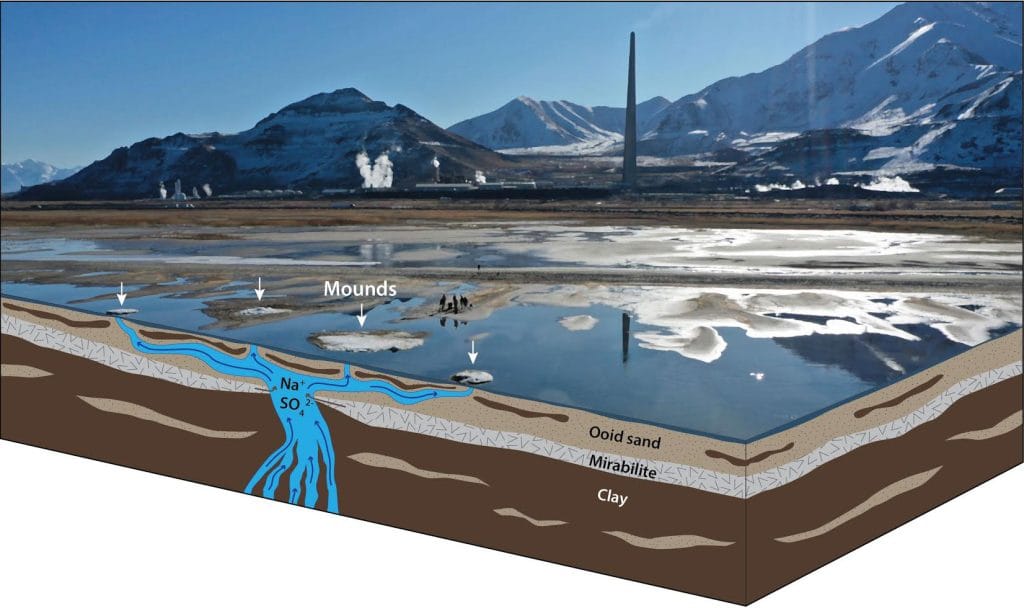
In cold weather, a new geological feature has shown up at Utah’s Great Salt Lake in the last decade. These salty mirabilite mounds form terraced crystals that resemble Yellowstone’s Mammoth Hot Springs.

Diagram showing salty springs feeding upward through layers of mirabilite to form a mound aboveground.Diagram showing how a salt-laden spring pushing upward through the mirabilite layer can then form mounds at the surface when the dissolved mirabilite recrystallizes after the water evaporates.

Mirabilite is hydrated sodium sulfate (as opposed to the sodium chloride of table salt). The structures form when upwelling spring water partially dissolves the layer of mirabilite found beneath the lake bed. That sulfate-laden water rises to the surface, where it freezes into the crystals seen here.

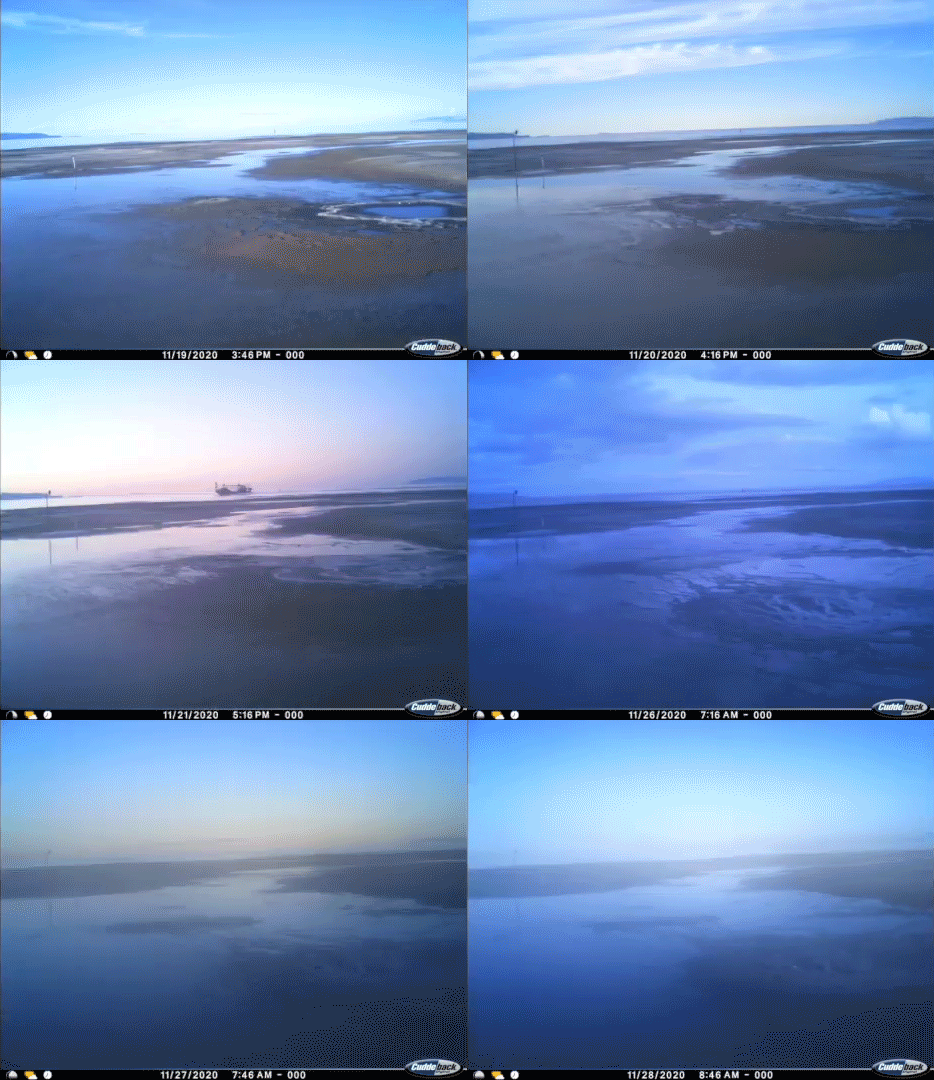
A timelapse showing mirabilite mounds forming.A timelapse showing the formation of mirabilite mounds.

When temperatures rise above freezing, the water in the mirabilite evaporates, leaving behind white, powdery thenardite. (Video credit: Great Salt Lake Institute; image credit: Utah Geological Survey)

#crystalGrowth #dissolution #evaporation #fluidDynamics #freezing #geophysics #physics #science
en.wikipedia.org
0
0
0
0
Open post
Nicole Sharp @admin@fyfluiddynamics.com
· 3mo ago
Oyster Reefs Sequester Nitrogen

The US eastern seaboard was once blanketed with oyster beds, but overharvesting, pollution, and habitat destruction decimated the population. As filter-feeders, oysters are naturally good at cleaning intertidal zones, and the reefs they build by cementing themselves to one another provide valuable habitat for many species of fish. A new study shows that oysters are even more economically valuable than we knew, thanks to their ability to sequester nitrogen.

Agricultural and industrial run-off carries nitrates into the ocean in high concentrations that trigger deadly phytoplankton blooms, which choke off oxygen levels for larger species like fish. One way to reduce nitrogen levels in the water is denitrification, a process where microbes break down the nitrate into, among other things, inert nitrogen gas. The surface of oyster reefs is one place where this happens. But nitrates that evade these microbes can also get trapped and buried by a growing oyster reef.

To understand how much nitrogen an oyster reef can bury, researchers studied cores removed from restored oyster beds. Below the top ten centimeters (where microbes do their denitrification), nitrogen levels in the oysters increased, with a square meter of oyster reef, on average, sequestering 6 grams of nitrogen per year, comparable to the amount that microbes removed. But some oyster reefs outperformed others. In particular, intertidal flat reefs–which grow faster–buried more than twice the nitrogen of subtidal reefs.

The team estimated that, in North Carolina’s Carteret County, oyster reefs sequester some 120,000 kilograms of nitrogen annually, at an economic value of over $3 million. (Image credit: J. Andrews/UNC-Chapel Hill; research credit: A. Smiley et al.; via Eos)

#biology #filterFeeding #filtration #fluidDynamics #ocean #oysters #physics #science
doi.org
0
1
0
0
Open post
Nicole Sharp @admin@fyfluiddynamics.com
· 3mo ago
“Tadpoles: The Big Little Migration”

Amphibians like toads are often indicator species for their ecosystem because they are vulnerable to changes on both land and water. In this short film, videographer Maxwel Hohn follows the migration of western toad tadpoles in British Columbia, showing their daily underwater journey from deep waters, where they can hide, to warmer, shallow waters, where they eat. Over the days and weeks of their early life, millions of tadpoles make the journey, their bodies morphing as they do. Eventually, they will hop away as toadlets. (Video and image credit: M. Hohn et al.)

#biology #fluidDynamics #physics #science #swimming #tadpoles
maxwelhohn.com
0
0
0
0
Open post
Nicole Sharp @admin@fyfluiddynamics.com
· 6mo ago
Observing Ice Giant Atmospheres

Uranus is one of our solar system’s oddest inhabitants, stuck spinning on its side with a tilted and offset magnetosphere. To better understand it, a team observed the planet for 17 hours with JWST. The near-infrared measurements gave new insight into the planet’s ionosphere, where auroras form. They found that temperatures peaked between 3,000 and 4,000 kilometers, while ion densities peaked at 1,000 kilometers. They also confirmed previous observations that Uranus’s upper atmosphere is cooling down. (Image and video credit: ESA/Webb/NASA/CSA/STScI/P. Tiranti/H. Melin/M. Zamani; research credit: P. Tiranti et al.; via Gizmodo)

https://www.youtube.com/watch?v=3jsn1829OPw

#atmosphericScience #aurora #fluidDynamics #magnetohydrodynamics #physics #planetaryScience #science #Uranus
0
14
0
0
Open post
Nicole Sharp @admin@fyfluiddynamics.com
· 6mo ago
“Quiet Pulse” and “Another World”

Light shines dimly through the wall of an ice cave in this photograph by Marie-Line Dentler. Shaped by melting, pressure, freezing, and fracture, these structures are dynamic and ethereal. (Image credit: M. Dentler; via Colossal)

Detail of an ice cave in Iceland, by Marie-Line Dentler.View in an ice cave by Marie-Line Dentler. #fluidDynamics #fluidsAsArt #freezing #geophysics #iceFormation #melting #physics #science
worldphoto.org
0
15
0
0
Open post
Nicole Sharp @admin@fyfluiddynamics.com
· 2mo ago
Ice Giant or Magma Ocean World?

Uranus and Neptune–known as our system’s ice giants–are our least explored planets. Both have received exactly one flyby, from the Voyager 2 spacecraft. The data from those flybys remain our primary source of knowledge about each planet. The traditional model for each planet’s interior (dating back to before the flybys) consists of three layers: a rocky core; an icy mantle made up of water, ammonia, and methane; and a hydrogen/helium-rich atmosphere. That structure is one way to match the limited measurements we have from these planets, but, as today’s preprint study points out, it’s not the only way.

The authors suggest an alternative structure, in which a hydrogen-rich atmosphere overlays a supercritical magma ocean capable of dissolving hydrogen into heavier, metallic elements. Their suggestion is motivated by several factors. First, objects in the outer solar system–including Kuiper Belt objects–have less icy material than originally assumed, which suggests that Uranus and Neptune’s progenitors wouldn’t have been so ice-rich, either. Second, our understanding of how “rocky” materials respond at the temperatures and pressures found in these planet interiors has evolved. In particular, silicate, hydrogen, and iron are actually miscible at these conditions. That means that discrete sub-layers separated by material type are not as likely.

Using the magma ocean model, the team found compositions for both Uranus and Neptune that conformed well to our limited data about their gravitational and magnetic field properties. Time–and more data–will tell as to which interior model best describes these enigmatic giants. (Image credit: NASA; research credit: E. Young et al. (preprint); via Gizmodo)

#fluidDynamics #geophysics #magma #miscibility #numericalSimulation #physics #planetaryScience #science #supercriticalFluids
arxiv.org
0
0
0
0
Open post
Nicole Sharp @admin@fyfluiddynamics.com
· 2mo ago
Even Penguins Love Bubbles

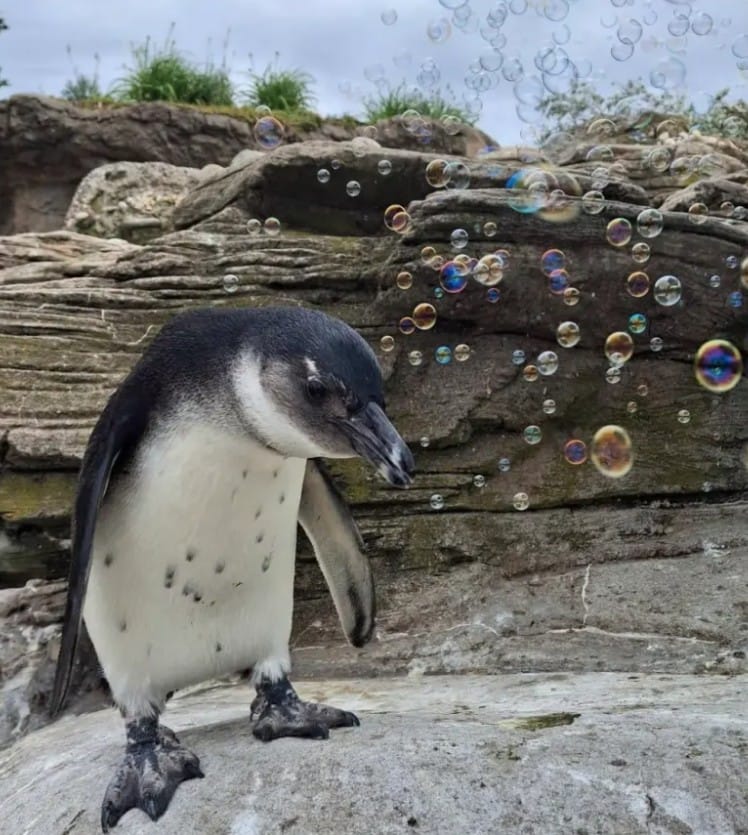
Walter, a young African penguin at the New York Aquarium, loves soap bubbles. In fairness to Walter, so do most people I’ve met. There’s just something that feels a bit magical about these ephemeral rainbow spheres that pop at a (dry) touch.

Bubbles owe their colors to thin film interference–the colors actually indicate how thick the bubble film is–and their stability (and fast disintegration) to surface tension. With schlieren photography or flow visualization, watching bubbles gets even cooler. Do you suppose a penguin would appreciate bubbles popping at 50,000 fps? (Image credit: New York Aquarium; via PopSci)

Walter the African Penguin enjoys popping bubbles. #biology #fluidDynamics #penguins #physics #science #soapBubbles
instagram.com
0
1
0
0
Open post
Nicole Sharp @admin@fyfluiddynamics.com
· 2mo ago
Pacific Surf

Life in Venice Beach lends itself to wave-watching, or so it seems for photographer Craig Hubbard. His portraits of waves and surfers are ethereal, every swell capped by a cloud-like swath of spray. Somehow, every photographer seems to capture breaking waves a little differently! (Image credit: C. Hubbard; via Colossal)

#breakingWave #fluidDynamics #fluidsAsArt #oceanWaves #physics #science
shotswithcraig.com
0
0
0
0
Open post
Nicole Sharp @admin@fyfluiddynamics.com
· 2mo ago
A Fluidic Space Telescope

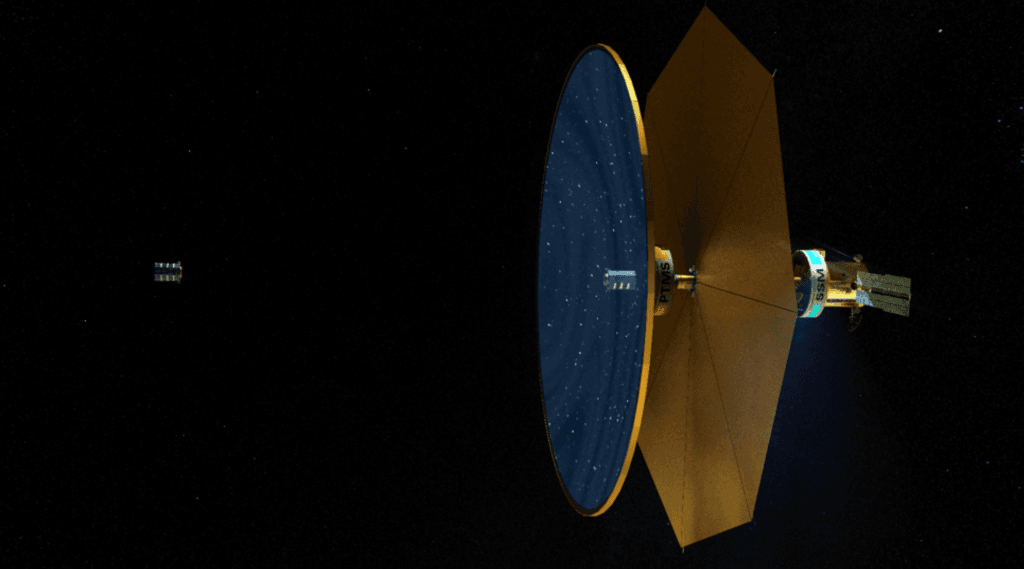
A telescope’s resolution is set by the size of its reflective surface. Our largest space telescope, JWST, has a 6.5-meter reflector, the largest we could manage given manufacturing constraints and the need to launch it in a rocket. To reach even larger sizes, researchers are considering a new type of reflector: one made of liquid.

A fluidic telescope has some obvious advantages: surface tension makes it atomically smooth, and liquids can be packed into any convenient shape for launch. But there are challenges, also. Like, what happens to the reflector when you point it in an new direction?

That’s what this study looks at, mathematically. Using a mathematical model of a 50-meter-wide, millimeter-thick fluid, the researchers analyzed how different maneuvers over the telescope’s lifetime would affect the image quality.

Shifting the reflector creates perturbations in the surface, initially at the mirror’s edges. Over time, those perturbations move toward the center of the mirror and, at the same time, decay. The team found that, while typical space telescope operations distorted parts of the mirror beyond the limits of good optical quality, the inner 80% of the mirror could remain undisturbed for twenty or more years. That would be like having a 40-meter telescope in orbit with more than 6x the resolution of JWST. (Image credit: NASA; research credit: I. Gabay et al.)

An artist's conception of a fluidic space telescope, made with a liquid reflecting surface tens of meters wide. #astronomy #fluidDynamics #numericalSimulation #optics #physics #science #surfaceTension
en.wikipedia.org
0
0
0
0
Open post
Nicole Sharp @admin@fyfluiddynamics.com
· 3mo ago
Fixing Mosul Dam

Keeping the water in a reservoir is an obvious challenge for any dam. But for Iraq’s Mosul Dam, it’s especially challenging because the dam was built on a foundation of gypsum, a highly water-soluble mineral. Since it was built, Mosul Dam’s water has been eating away at the underlying bedrock, making sinkholes, forcing gaps, and generally working its way out. That, obviously, creates a huge risk for dam failure and massive downstream flooding.

To get the dam stabilized–at least to a point where Iraqi engineers could keep up with filling the holes as they form–took a massive international engineering project, carried out in the shadow of armed conflict. (Video and image credit: Practical Engineering)

#civilEngineering #civilInfrastructure #dams #dissolution #fluidDynamics #physics #science
fyfluiddynamics.com
0
1
0
0
Open post
Nicole Sharp @admin@fyfluiddynamics.com
· 3mo ago
Swirls Above the Southern Ocean

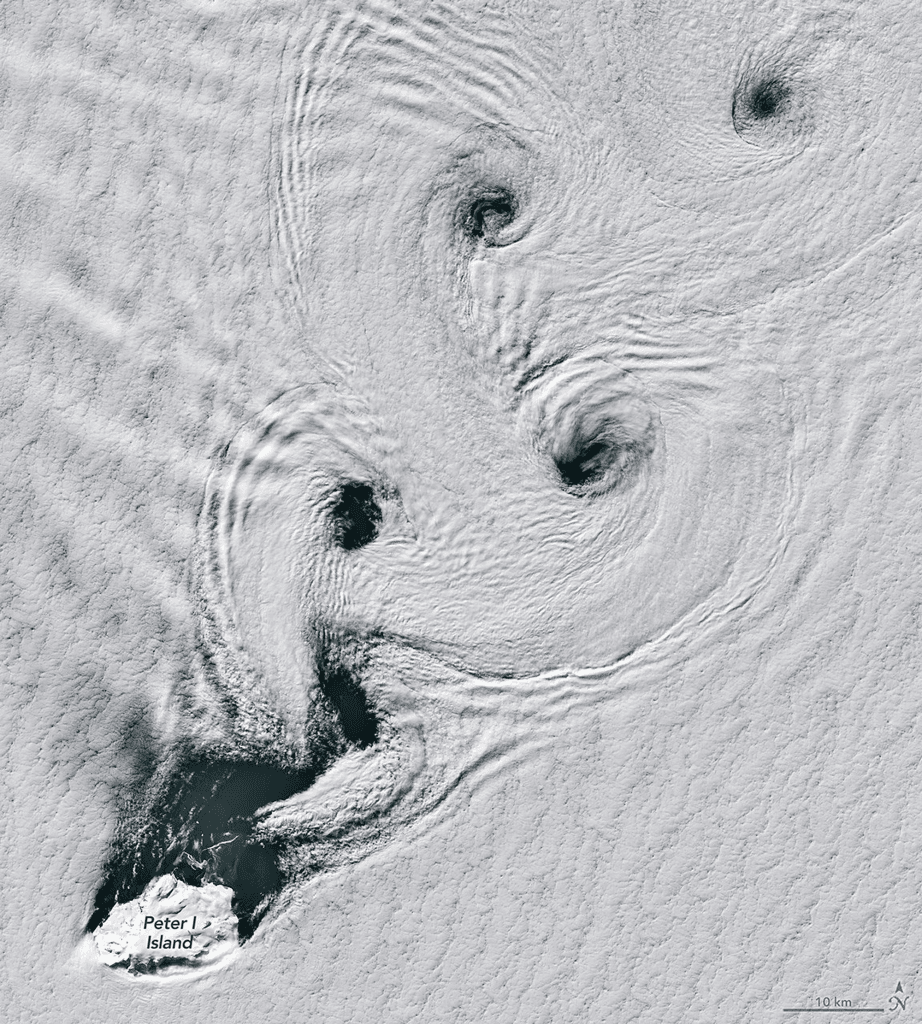
In the Southern Ocean, obstacles are sparse. But the ice-cloaked volcano of Peter I Island is tall enough at over 1600 meters to disrupt the wind. At steady wind speeds between about 18 to 54 kilometers per hour, flowing past the island creates vortices that shed from one side and then the other. The result is a von Karman vortex street like the one seen here, flowing toward the upper right.

The overlaid ripple structures in the cloud layer are reminiscent of gravity waves. Perhaps, the wind’s passage made some lee waves that the vortices distorted? (Image credit: M. Garrison; via NASA Earth Observatory)

A von Karman vortex street stretches downstream from Peter I Island. #flowVisualization #fluidDynamics #gravityWave #leeWaves #physics #satelliteImage #science #vonKarmanVortexStreet
science.nasa.gov
0
0
0
0
Open post
Nicole Sharp @admin@fyfluiddynamics.com
· 7mo ago
Icy or Rocky Giants?

On the outskirts of our solar system, two enigmatic giants loom: Uranus and Neptune. In terms of mass and size, both resemble many of the exoplanets discovered in recent years. Within our own solar system, these planets are known as “icy giants,” but a new study suggests that moniker may be wrong.

Pinning down the interior composition of a planet is tough on limited measurements. In the case of these outer planets, our main data is gravitational, recorded from visiting spacecraft. That information cannot tell us directly what the composition of a planet is, but it gives constraints for what materials could produce such a gravitational field.

Hubble images of Uranus (left) and Neptune (right).

In their simulation, researchers began with random interior configurations for Uranus and Neptune, then had the model iterate through configurations to simultaneously match the gravitational measurements while satisfying the thermodynamic and physical constraints of a stable planet. By repeating the process several times, the researchers created a catalog of potential interiors for Uranus and Neptune. And while some were water-rich–consistent with the “icy giant” title–others were remarkably rocky.

The team suggests that we may need to retire that moniker and consider the possibility that these worlds are more like our own than we thought. To find out which is true, we will need more spacecraft to visit our frigid neighbors, to provide new gravitational measurements and other observations. (Image credit: NASA/ESA/A. Simon/M. Wong/A. Hsu; research credit: R. Morf and L. Helled; via Physics World)

#fluidDynamics #geophysics #Neptune #numericalSimulation #physics #planetaryScience #science
doi.org
0
1
0
0
Open post
Nicole Sharp @admin@fyfluiddynamics.com
· 2mo ago
Convection Inside the Mantle

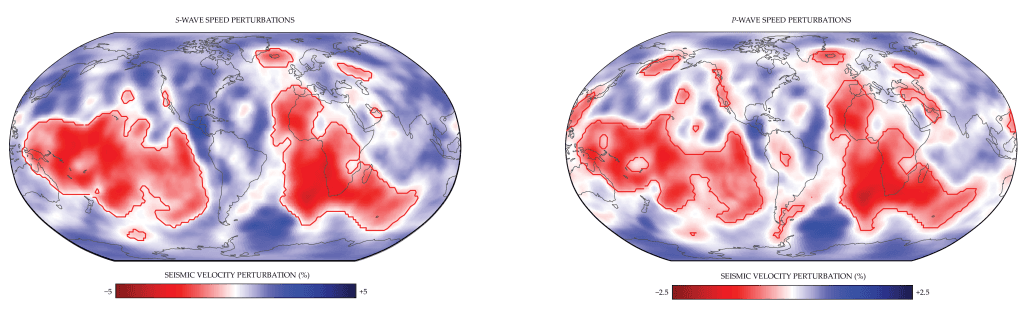
Most of what we know about Earth’s interior comes from observing how seismic waves–mostly from earthquakes–bounce around. As our observations have gotten better–more seisometers, better imaging techniques–scientists have identified two large anomalies sitting near the bottom of the mantle. Known as large low-velocity provinces, or LLVPs, these zones take up continent-sized areas beneath parts of Africa and the Pacific.

Seismic waves show lower speeds in large, continent-sized zones that sit beneath Africa and the Pacific. These large low-velocity provinces (LLVPs) are outlined in red.Seismic waves show lower speeds in large, continent-sized zones that sit beneath Africa and the Pacific. These large low-velocity provinces (LLVPs) are outlined in red.
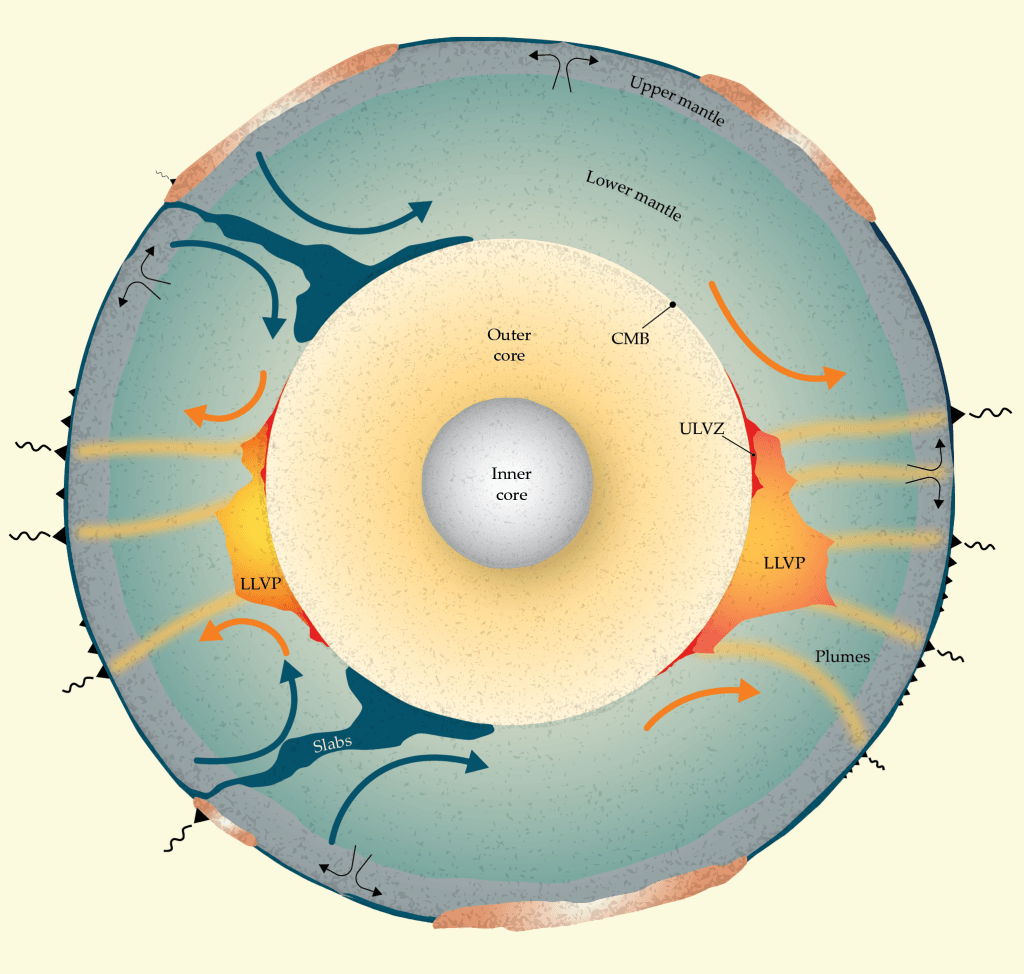
The LLVPs are hot, which would normally make them buoyant, but their stationary nature suggests they are made up of extremely dense material. Narrow plumes of hot material make their way up from the LLVPs to form volcanic hotspots like those that made the Hawaiian and Galapagos Islands. Balancing that upward convection is the downward convection of former tectonic material carried into the mantle at subduction zones.

What the LLVPs are made of remains an active research question. One suggestion is that they contain remnants of Theia, the planet thought to have impacted the proto-Earth to form our Moon. (Image credits: E. Garnero and C. Richardson; see also Physics Today)

Illustration showing convection in the Earth's inner mantle. Former tectonic material subducts downward in dark blue zones. The large low-velocity provinces (LLVPs) are shown in orange. Hot-spot volcanic activity is seen at the surface (black triangles) above narrow plumes that lift material from the LLVPs toward the surface.Illustration showing convection in the Earth’s inner mantle. Former tectonic material subducts downward in dark blue zones. The large low-velocity provinces (LLVPs) are shown in orange. Hot-spot volcanic activity is seen at the surface (black triangles) above narrow plumes that lift material from the LLVPs toward the surface. #buoyancy #convection #fluidDynamics #geophysics #mantleConvection #physics #science #seismicWaves
en.wikipedia.org
0
0
0
0
Open post
Nicole Sharp @admin@fyfluiddynamics.com
· 2mo ago
Making Quieter Shock Waves

NASA’s X-59 aircraft is intended to demonstrate supersonic flight without the boom. Although it’s broken into supersonic speeds, we haven’t yet heard its “sonic thump” because, so far, it’s been accompanied by conventional supersonic aircraft, which are louder.

The idea behind the long, skinny X-59 is to create weaker, widely-spaced shocks along the aircraft body. Weaker shocks are easier for atmospheric effects to damp out before they reach the ground, and spacing them out makes it harder for them to “pile up” at the nose and tail to create the strong double shocks that merge into a sonic boom.

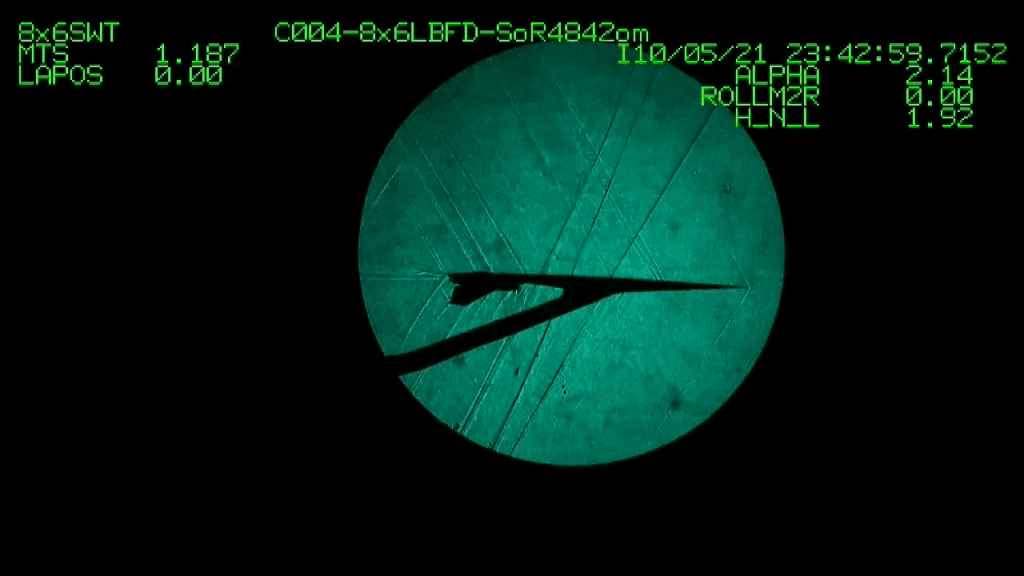
Schlieren image of a model X-59 tested at supersonic conditions in a wind tunnel.Schlieren image of a model X-59 tested at supersonic conditions in a wind tunnel. The model is mounted upside-down. The three dark diagonal lines are shock waves originating from the wind tunnel and can be ignored. The fainter lines coming off parts of the aircraft model are the plane’s shock waves.
NASA is preparing to test the X-59’s in-flight shocks soon, including with in-air schlieren photography like they’ve done in the past for other aircraft. But we’ve already have a glimpse of what to expect, thanks to wind tunnel testing, shown above. Ignore the three dark diagonal lines in the middle of the image (those are from the wind tunnel, not the model aircraft), and focus instead on the thin bright lines coming off the plane. Those are some impressively subtle shock waves!

Hear more from the aircraft’s designer and test pilots in this Ars Technica article. (Image credit: NASA; see also: Ars Technica, M. Ahaus et al.)

#fluidDynamics #physics #schlierenPhotography #science #shockwave #supersonic #supersonicFlight #supersonicWindTunnel #windTunnelTesting
ntrs.nasa.gov
0
0
0
0
Open post
Nicole Sharp @admin@fyfluiddynamics.com
· 3mo ago
Burning Oil Spills With Fire Whirls

Though they are relatively infrequent, large marine oil spills, like 2010’s Deepwater Horizon, are devastating and incredibly difficult to clean up. In many locations, the “best” option for responding to such disasters is burning off the oil before it can absorb enough water to sink. But these floating fires leave behind unburned oil and produce soot. To enhance the burn, researchers are looking at the possibility of triggering large-scale fire whirls.

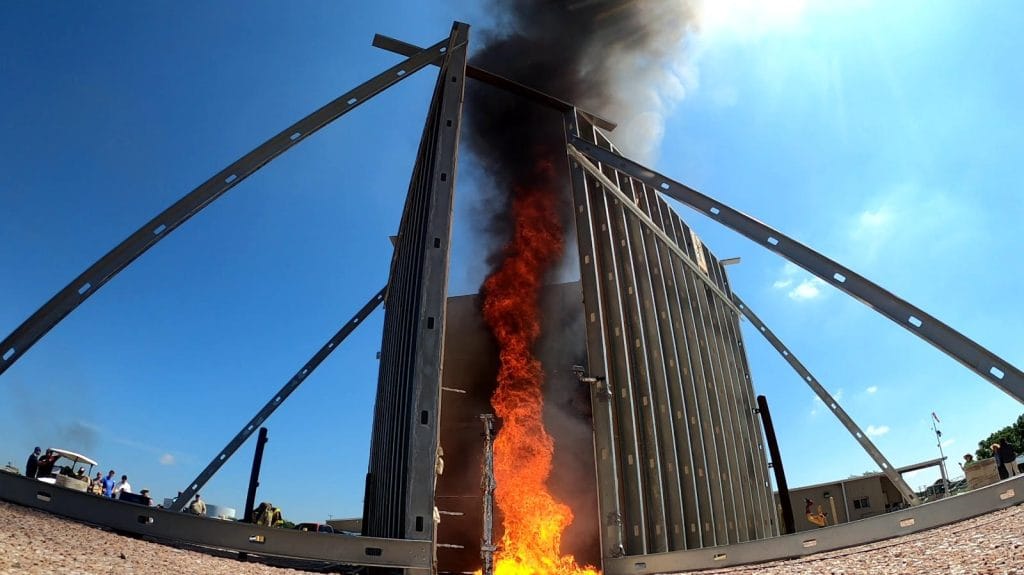
Often seen in wildfires, these fire vortices are intense and localized. Researchers made a more than 5-meter tall version in these experiments by arranging three walls that spun up the in-flowing air. The fire whirl sat above a pool of water topped in a layer of oil that served as the whirl’s fuel.

Within the whirl, the fire’s burn rate was 40% higher than a typical pool fire, and soot production was 40% lower–showing that fire whirls can burn cleaner. But the whirls are more finicky to start and maintain. It’s not yet clear whether such intense whirls are possible in the chaotic conditions on the ocean. (Research and image credit: W. Cui et al.; via Eos)

View of a large-scale fire whirl experiment built around an oil spill on a pool. #combustion #fireTornado #fireWhirl #fluidDynamics #oilSpill #physics #pollution #science
doi.org
0
0
0
0
Open post
Nicole Sharp @admin@fyfluiddynamics.com
· 3mo ago
The Teton Dam Failure
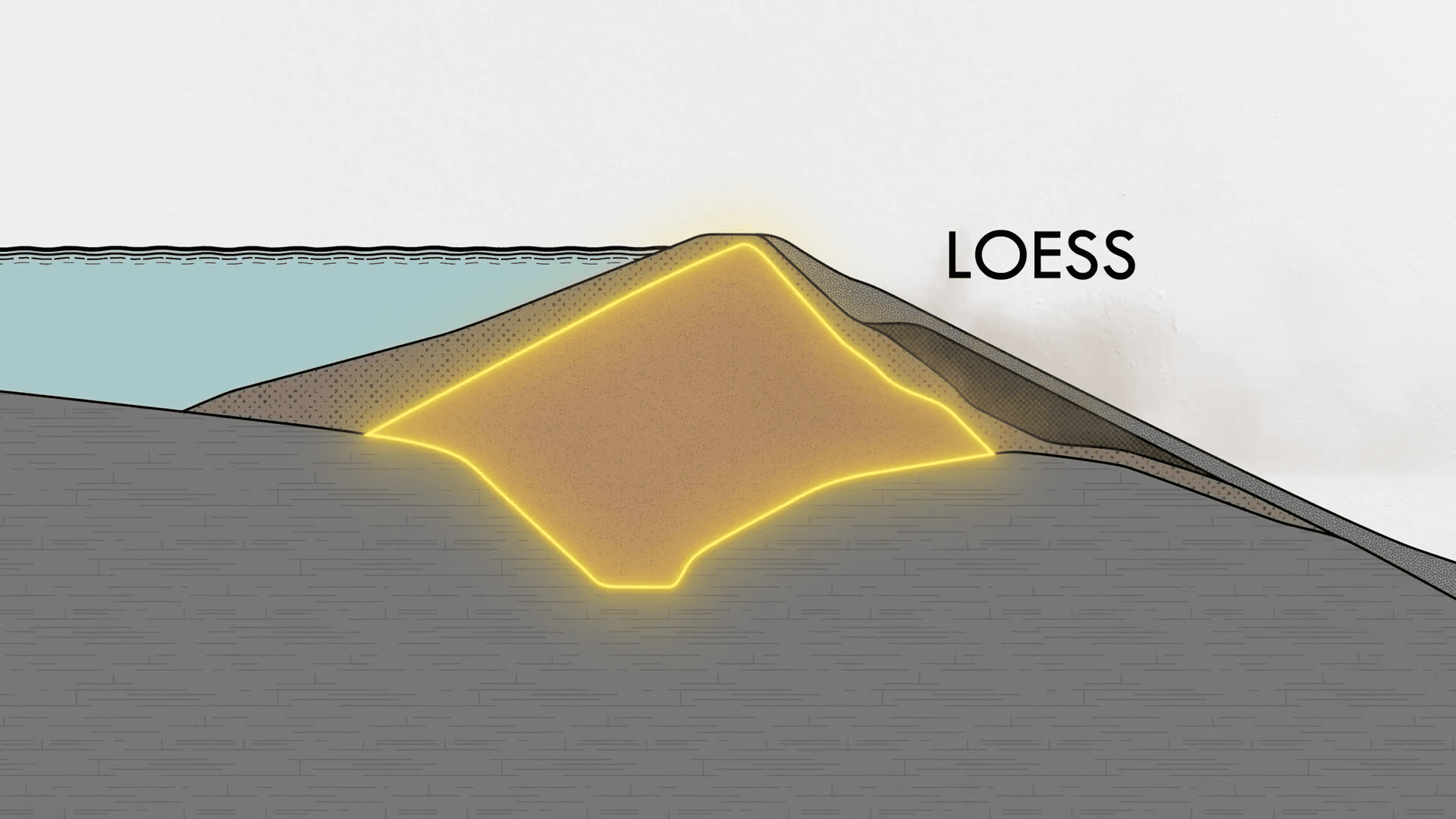
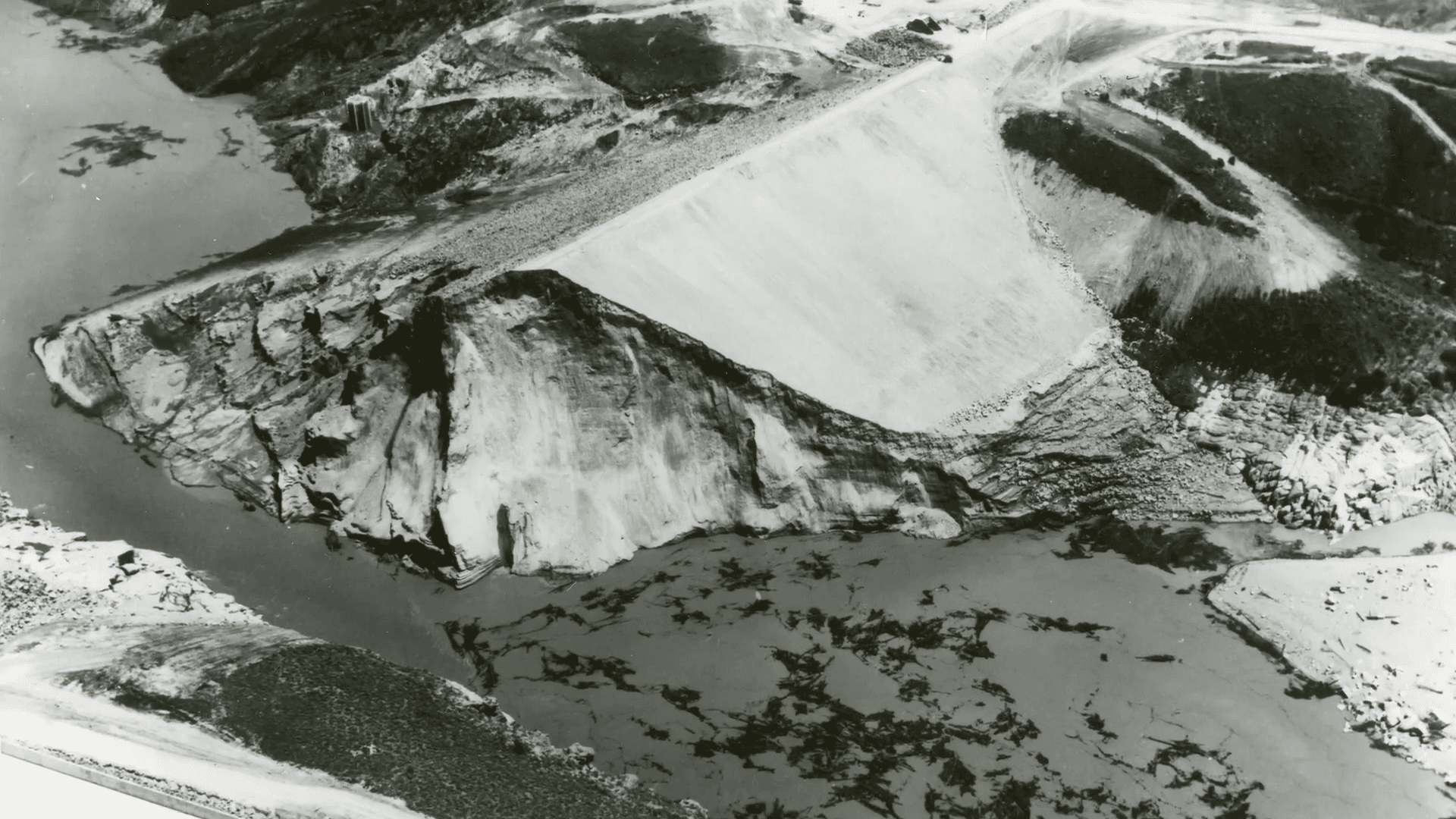
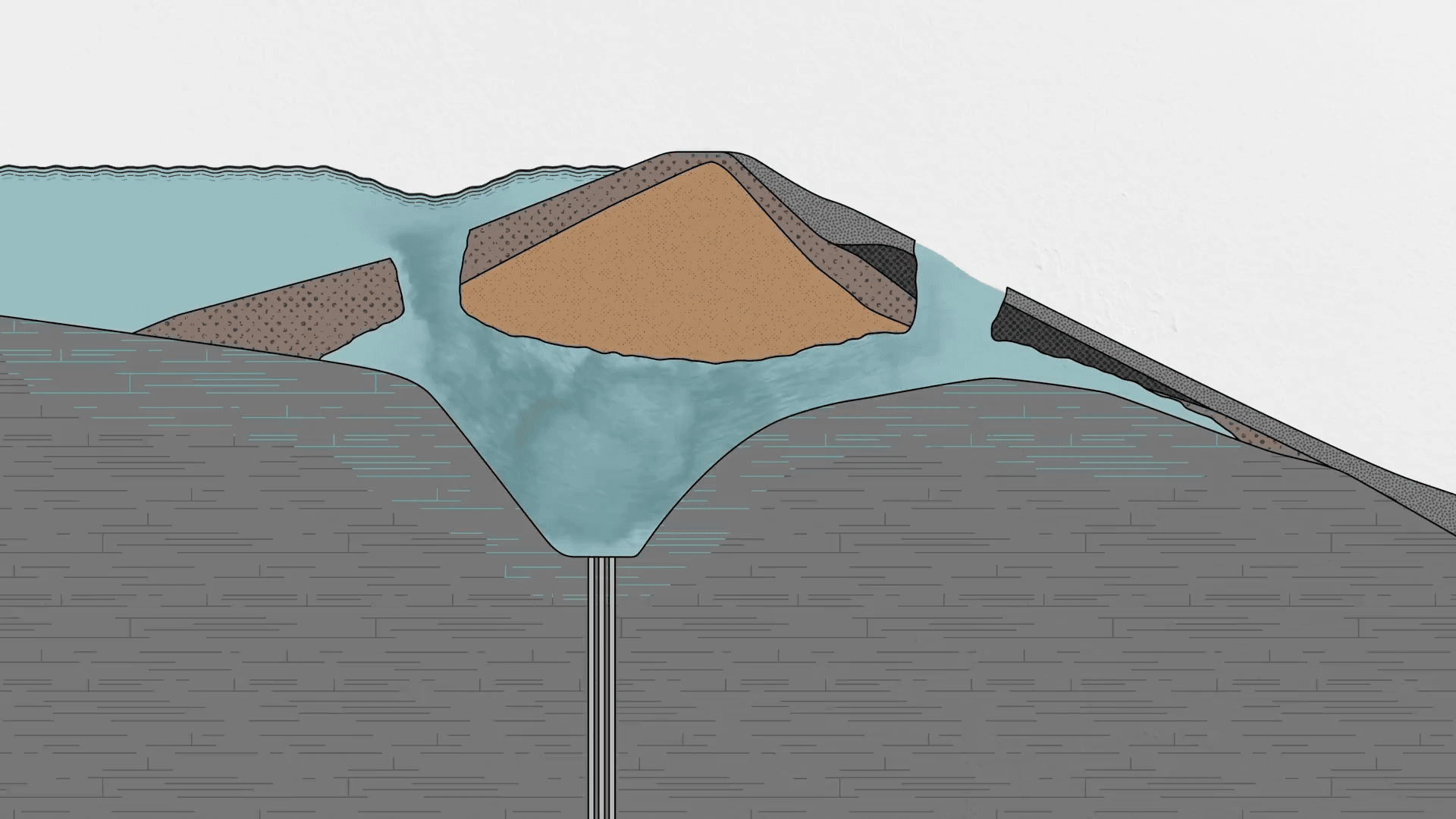
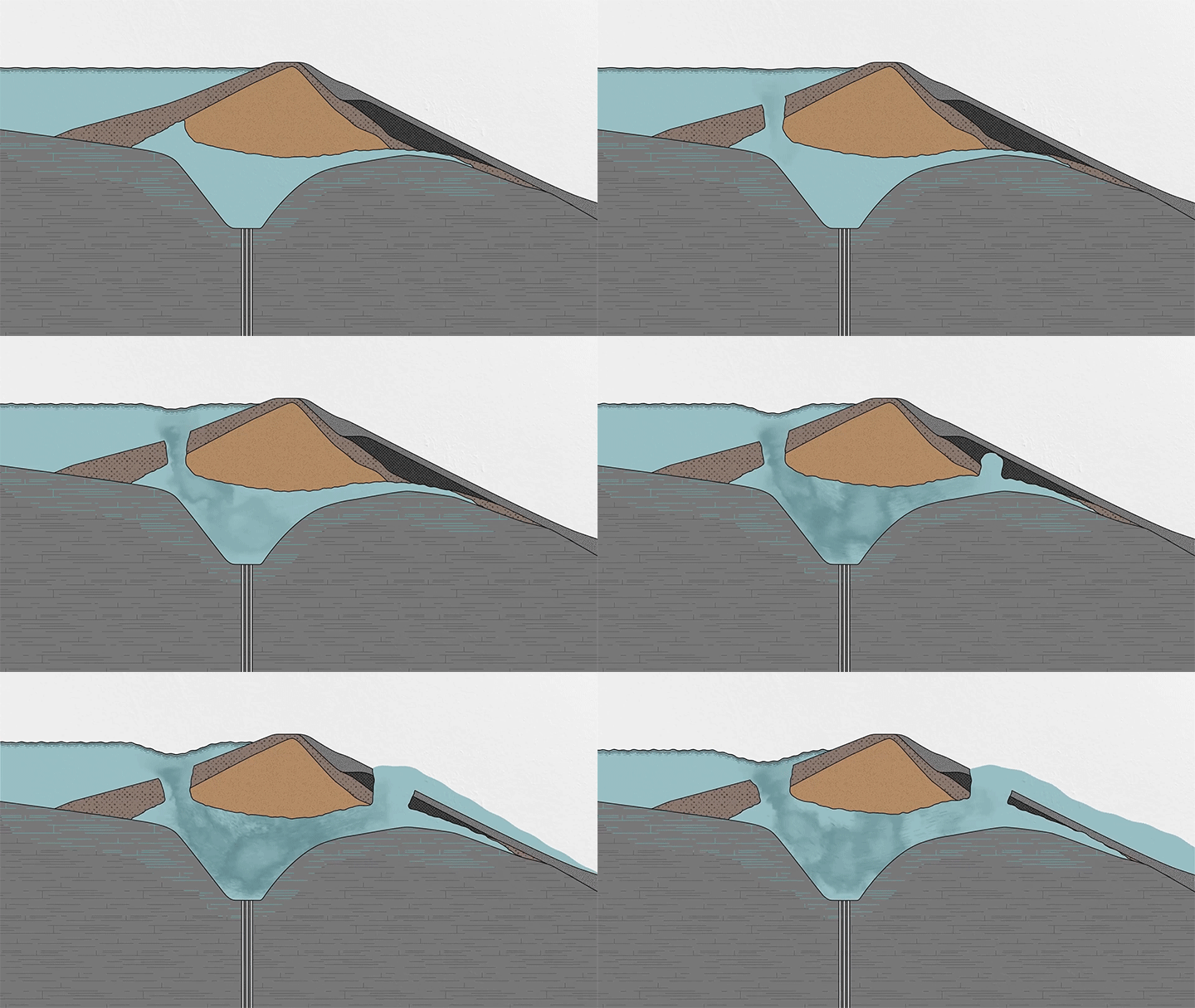
The core of the Teton Dam was made of loess, a strong but porous sediment.
Aerial view of the Teton Dam after failure.
Once undermined, water quickly tunneled through and drained out the dam.
The core of the Teton Dam was made of loess, a strong but porous sediment.Aerial view of the Teton Dam after failure.Once undermined, water quickly tunneled through and drained out the dam.

Engineering failures always leave us with lessons learned. The failure of Teton Dam in 1976 triggered an overhaul in how we manage dam construction and regulation. As Grady describes in this Practical Engineering video, the earthen dam was built with fundamental flaws that allowed water to carve pathways beneath and through the sediment meant to hold it. Although the dam cost $100 million to build, its failure cost the federal government over three times that in claims. (Video and image credit: Practical Engineering)

#civilEngineering #damFailure #fluidDynamics #infrastructure #physics #porousFlow #science
fyfluiddynamics.com
0
0
0
0
Open post
Nicole Sharp @admin@fyfluiddynamics.com
· 7mo ago
Sprites and ELVES

Although we are most familiar with the white, branching lightning caused by electrical discharge between clouds and the ground, there are many types of lightning. This fortuitous image captures two: tentacled red sprites and ring-like ELVES. Sprites extend upward from the top of a thunderstorm, in a large but weak flash that lasts only seconds. ELVES appear as a rapidly-expanding disc, thought to be caused by an energetic electromagnetic pulse moving into the ionosphere. They were first discovered in footage from a 1992 Space Shuttle mission. (Image credit: V. Binotto; via APOD)

#fluidDynamics #lightning #magnetohydrodynamics #meteorology #physics #plasma #science #sprite #thunderstorm
instagram.com
0
15
0
0
Open post
Nicole Sharp @admin@fyfluiddynamics.com
· 6mo ago
Replying to
@demallien@mindly.social LOL! I definitely did not think of that comparison when I scheduled this post. That said, I’ve got posts on Guinness physics, too: https://fyfluiddynamics.com/tagged/beer/
fyfluiddynamics.com
0
0
0
0
Open post
Nicole Sharp @admin@fyfluiddynamics.com
· 2mo ago
Where Waves Carry Plastics

The classic theory of steady wave motion predicts a phenomenon called Stokes drift, in which particles spread horizontally in the direction of wave travel. That means that something like microplastics will drift in the direction that waves are traveling. But in the real world, ocean waves aren’t quite so neat and unchanging. A new study looks at what happens when waves are decaying in strength–in other words, what happens in our world when the wind dies down.

In those circumstances, the researchers found that particles did not just drift horizontally–they drifted vertically, too. Further, how much a particle drifts vertically depends on its initial depth. Since plastics vary in their buoyancy–and can be found in varying numbers and sizes throughout the upper layer of the ocean–this mechanism could significantly affect how waves mix and transport pollution. (Image credit: N. Jensen; research credit: T. Izawa et al.; via Physics World)

#fluidDynamics #oceanWaves #physics #plasticPollution #science #stokesDrift
en.wikipedia.org
0
0
0
0
Open post
Nicole Sharp @admin@fyfluiddynamics.com
· 3mo ago
Vanishing Spirits: Cognac

Years ago, photographer Ernie Button discovered an intriguing stain left behind in his whiskey glass after the last drops evaporated. That discovery led both to beautiful images and an entire scientific paper analyzing how the alcohol, surfactants, and polymers in the whiskey combined to leave such a uniform stain. Over the years, Button continued investigating liquor stains, looking at gin, rice whisky, and aging effects. Here, he’s turned his lens to cognac, producing stains that look like oil slicks, aerial landscapes, and even cartoonish faces! (Image and submission credit: E. Button)

#alcohol #chemistry #evaporation #fluidDynamics #fluidsAsArt #marangoniEffect #physics #science
erniebutton.com
0
0
0
0
Back
313k7r1n3
Elektrine

Tor hidden service

elekhj7afj4qnrr4yd3bkzslsyo5jgfxw3orgjkhlcxifueodybyiiad.onion

I2P eepsite

j6b6cyk6gjmepjih7jjadxgxvvf3lzzujljuu2v4biemzpg3naya.b32.i2p

Platform

  • Email
  • Chat
  • Timeline
  • VPN
  • DNS

Company

  • About
  • Contact
  • FAQ
  • Lite (no JS)

Legal

  • Terms of Service
  • Privacy Policy
  • Transparency Report
  • Report Abuse
  • Warrant Canary
  • VPN Policy

Support

  • support@elektrine.com
  • Report Security Issue
Mail client setup IMAP mail.elektrine.com:993 POP3 mail.elektrine.com:995 SMTP mail.elektrine.com:465
© 2026 Elektrine. All rights reserved. Server: 22:08:54 UTC