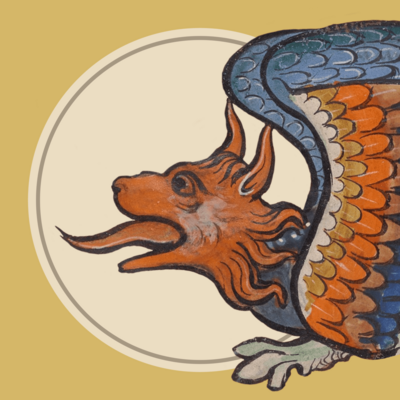
lār-lēast, f.n: lack of learning or instruction. (LAHR-LAY-ost / ˈlaːr-ˌleːast)
#OldEnglish #WOTD
 mastodon 4.8.0-nightly.2026-10-06
Old English Word of the Day, by Dr Hana Videen, author of THE WORDHORD: DAILY LIFE IN OLD ENGLISH and THE DEORHORD: AN OLD ENGLISH BESTIARY.
wæter-stefn, f.n: the voice or sound of water. (WAT-er-STEH-vun / ˈwæ-tɛr-ˌstɛ-vən)
Image: Bestiary; Iran (Maragheh), c. 1297-1300; Morgan Library & Museum, MS M.500, f. 78v.
#OldEnglish #WOTD
ge-dwol-þing, n.n: an erroneous thing, deceit. (yeh-DWOLL-thing / jɛ-ˈdwɔl-θɪŋ)
Image: Maastricht Hours; Netherlands (Maastricht), 1300-1325; British Library, Stowe MS 17, f. 84r.
#OldEnglish #WOTD
in-timbrian, wk.v: to instruct. (in-TIM-bri-ahn / ɪn-ˈtɪm-brɪ-an)
Image: Scholastic Miscellany; France (Paris), c. 1309-1316; British Library, MS Burney 275, f. 293.
#OldEnglish #WOTD
wæstm-līc, adj: fruitful. (WASS-tum-leech / ˈwæs-təm-liːtʃ)
Image: The labours of March in a Psalter; England, 13th century; Cambridge, Trinity College, B.11.4, d. ii r.
#OldEnglish #WOTD
ge-mǣtan, wk.v: to dream. (yeh-MAT-ahn / jɛ-ˈmæː-tan)
Image: The Dream of the Magi from a psalter; England (Oxford), 1200-1220; British Library, Royal MS 1 D X, f. 2v.
#OldEnglish #WOTD
cæppe, f.n: cloak, cape, usually hooded, especially an ecclesiastic’s cloak; chasuble; hood, cap. (KAP-puh / ˈkæp-pə)
Image: Sylvester II making an organ play by steam; France (Amiens?), 1300-1310; Morgan Library & Museum, MS M.751, f. 100r.
#OldEnglish #WOTD
Engla þēod, n: country or nation of the English. (ENG-gla-THAY-od / ˈɛŋ-gla-ˌθeːɔd)
Image: Matthew Paris map of Britain; England (St Albans), 1250; British Library, MS Cotton Claudius D VI, f. 12v.
#OldEnglish #WOTD
wīsdōm, m.n: wisdom, knowledge, learning, philosophy. (WEEZ-doam / ˈwiːz-doːm)
Image: Boethius’ Consolation of Philosophy; Austria (Salzburg), c. 1000; Munich, Bayerische Staatsbibliothek, Clm 15825, f. 1v.
#OldEnglish #WOTD
mīn, pronoun: of me, mine. (MEEN / ˈmiːn)
#OldEnglish #WOTD
ge-nerenes, f.n: a taking away, deliverance. (yeh-NEH-reh-ness / jɛ-ˈnɛ-rɛ-nɛs)
Image: Harrowing of Hell in Miroir Historial; France, 14th century; Bibliothèque nationale de France, Département des Manuscrits, Français 312, f. 317v.
#OldEnglish #WOTD
drēorig, adj: suffering from or causing anguish, grief, horror or misery. (DRAY-oh-rih / ˈdreːɔ-rɪj)
#OldEnglish #WOTD
frēfrend, m.n: comforter, consoler. (FRAY-frend / ˈfreː-frɛnd)
#OldEnglish #WOTD
emn-scēolere, m.n: a fellow scholar. (EH-mun-SHAY-oll-leh-ruh / ˈɛ-mən-ˌʃeːɔ-lɛ-rə)
Image: Romance of Alexander; Belgium (Tournai), 14th century; Bodleian Library, MS Bodley 264, f. 96r.
#OldEnglish #WOTD
ge-spelia, m.n: a substitute, deputy, vicegerent (an administrative deputy of a king or magistrate). (yeh-SPEH-li-ah / jɛ-ˈspɛ-lɪ-a)
#OldEnglish #WOTD
nirwett, m.n: narrowness; a narrow place, pass; oppression of the chest, difficulty of breathing. (NIR-wet / ˈnɪr-wɛt)
#OldEnglish #WOTD
samod-wyrcende, adj: cooperating, working together. (SAH-mod-WUER-chen-duh / ˈsa-mɔd-ˌwyr-tʃɛn-də)
Image: Luttrell Psalter; N England (Lincolnshire), 1325-1340; British Library, Add MS 42130, f. 172v.
#OldEnglish #WOTD #InternationalWomensDay
tama, m.n: tameness. (TAH-ma / ˈta-ma)
Image: Romance of Alexander; Belgium (Tournai), 14th century; Bodleian Library, MS Bodley 264, f. 108r.
#OldEnglish #WOTD
bāsnian, wk.v: to expect, await. (BAHZ-ni-ahn / ˈbaːz-nɪ-an)
#OldEnglish #WOTD
dumb, adj: mute, unable to speak. (DUMB / ˈdʌmb)
Image: Reckoning gestures in computus collection; Italy (Piacenza?), 1018-1032; Morgan Library & Museum, MS M/925, f. 38r.
#OldEnglish #WOTD
geond-lēohtend, m.n: one who illuminates throughout or entirely; a hapax that mistakenly renders Latin perlustrator (one who examines entirely, surveyor) as if ‘illuminator of all’. (YEH-ond-LAY-o-h’tend / ˈjɛɔnd-ˌleːɔx-tɛnd)
#OldEnglish #WOTD
palm-trēow, m.n: a palm-tree. (PALM-TRAY-oh / ˈpalm-ˌtreːɔw)
Image: Benedictional of St Æthelwold; England (Winchester), mid to late 10th century; British Library, Add MS 49598, f. 45v.
#OldEnglish #WOTD
cyn-ren, n.n: family course, family, generation, kind, nation, posterity. (KUEN-ren / ˈkyn-rɛn)
#OldEnglish #WOTD
land-riht, n.n: the law (or body of laws) associated with an estate or district; the (collective) rights and privileges due to the owner of an estate or land. (LOND-RI’HT / ˈland-ˌrɪxt)
#OldEnglish #WOTD
anxsumnes, f.n: anxiety. (ONKS-sum-ness / ˈanks-sʌm-nɛs)
#OldEnglish #WOTD
hege, m.n: hedge, fence; boundary wall. (HEH-yuh / ˈhɛ-jə)
#OldEnglish #WOTD
min, adj: small; mean, vile. (MIN / ˈmɪn)
#OldEnglish #WOTD
cāfer-tūn, m.n: courtyard, hall, enclosure, court, vestibule. (KAH-ver-TOON / ˈkaː-vɛr-ˌtuːn)
#OldEnglish #WOTD
un-gegrēt, adj: ungreeted. (UN-yeh-GRATE / ˈʌn-jɛ-ˌgreːt)
#OldEnglish #WOTD
barþ, n: type of ship. (BARTH / ˈbarθ)
#OldEnglish #WOTD
frēogan, wk.v: to free, liberate (someone/something); to rescue, release; to love (mainly in poetry); to caress, embrace (someone) lovingly. (FRAY-o-gahn / ˈfreːɔ-gan)
#OldEnglish #WOTD #HugAMedievalistDay
meagol, adj: earnest, strenuous, firm. (MEH-ah-goll / ˈmɛa-gɔl)
#OldEnglish #WOTD
pull-spere, n.n: a ‘pool-spear’, reed (such as grows by pools). (PULL-SPEH-ruh / ˈpʌl-ˌspɛ-rə)
#OldEnglish #WOTD
ge-glengan, wk.v: to adorn, embellish, set in order, compose. (yeh-GLENG-gahn / jɛ-ˈglɛŋ-gan)
#OldEnglish #WOTD
mōt, n.n: a meeting, court. (MOAT / ˈmoːt)
#OldEnglish #WOTD
ealdhrȳþer-flǣsc, n.n: meat of a mature or full-grown bullock, glossing Latin succidia (joint of pork, flitch of bacon). (EH-ald-hrue-ther-FLASH / ˈɛald-hryː-θɛr-ˌflæːʃ)
#OldEnglish #WOTD
sigor-wuldor, n.n: triumphant glory, glory of the victor. (SIH-gor-WULL-dor / ˈsɪ-gɔr-ˌwʌl-dɔr)
#OldEnglish #WOTD
inlīce, adv: inwardly; earnestly, sincerely. (in-LEE-chuh / ɪn-ˈliː-tʃə)
#OldEnglish #WOTD
hādung-dæg, m.n: the anniversary of a person’s ordination. (HA-dung-DAIE / ˈhaː-dʌŋ-ˌdæj)
#OldEnglish #WOTD
for-dwīnan, str.v: to dwindle away, vanish. (for-DWEE-nahn / fɔr-ˈdwiː-nan)
#OldEnglish #WOTD
cēping, f.n: observation. (KAY-ping / ˈkeː-pɪŋ)
#OldEnglish #WOTD